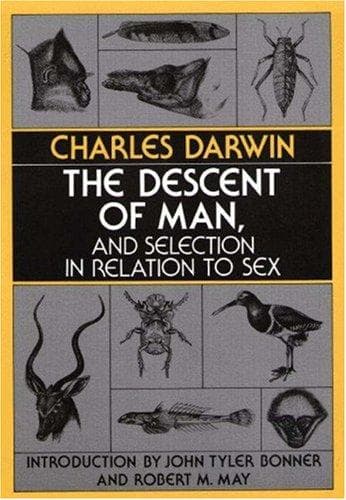
The Descent of Man, and Selection in Relation to SexDarwin, Charles
History
The Descent of Man, and Selection in Relation to Sex
Darwin, Charles
Evolution (Biology); Human beings -- Origin; Sex differences; Sexual dimorphism (Animals); Sexual selection in animals
to both sexes at a corresponding late period; and if so, these cases
are not opposed to our rule:—there exist sub-breeds of the pigeon,
described by Neumeister (46. ‘Das Ganze der Taubenzucht,’ 1837, ss. 21,
24. For the case of the streaked pigeons, see Dr. Chapuis, ‘Le pigeon
voyageur Belge,’ 1865, p. 87.), in which both sexes change their colour
during two or three moults (as is likewise the case with the Almond
Tumbler); nevertheless, these changes, though occurring rather late in
life, are common to both sexes. One variety of the Canary-bird, namely
the London Prize, offers a nearly analogous case.
With the breeds of the Fowl the inheritance of various characters by
one or both sexes, seems generally determined by the period at which
such characters are developed. Thus in all the many breeds in which the
adult male differs greatly in colour from the female, as well as from
the wild parent-species, he differs also from the young male, so that
the newly-acquired characters must have appeared at a rather late
period of life. On the other hand, in most of the breeds in which the
two sexes resemble each other, the young are coloured in nearly the
same manner as their parents, and this renders it probable that their
colours first appeared early in life. We have instances of this fact in
all black and white breeds, in which the young and old of both sexes
are alike; nor can it be maintained that there is something peculiar in
a black or white plumage, which leads to its transference to both
sexes; for the males alone of many natural species are either black or
white, the females being differently coloured. With the so-called
Cuckoo sub-breeds of the fowl, in which the feathers are transversely
pencilled with dark stripes, both sexes and the chickens are coloured
in nearly the same manner. The laced plumage of the Sebright bantam is
the same in both sexes, and in the young chickens the wing-feathers are
distinctly, though imperfectly laced. Spangled Hamburgs, however, offer
a partial exception; for the two sexes, though not quite alike,
resemble each other more closely than do the sexes of the aboriginal
parent-species; yet they acquire their characteristic plumage late in
life, for the chickens are distinctly pencilled. With respect to other
characters besides colour, in the wild-parent species and in most of
the domestic breeds, the males alone possess a well-developed comb; but
in the young of the Spanish fowl it is largely developed at a very
early age, and, in accordance with this early development in the male,
it is of unusual size in the adult female. In the Game breeds pugnacity
is developed at a wonderfully early age, of which curious proofs could
be given; and this character is transmitted to both sexes, so that the
hens, from their extreme pugnacity, are now generally exhibited in
separate pens. With the Polish breeds the bony protuberance of the
skull which supports the crest is partially developed even before the
Public-domain text, read in full here on John Shaqi.
Reviews
Reviews
No reviews yet
Be the first to share your thoughts on this work.
Elsewhere in the archive
Join the Discussion
Join the discussion
Sign in to leave a comment or review.
Sign InorCreate an account