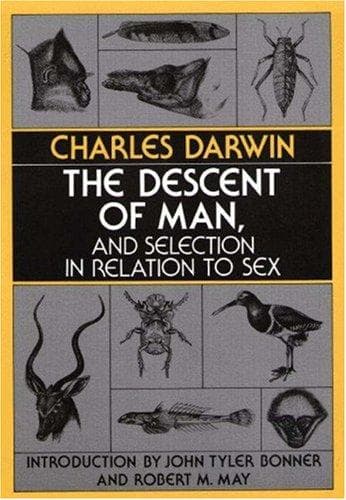
The Descent of Man, and Selection in Relation to SexDarwin, Charles
History
The Descent of Man, and Selection in Relation to Sex
Darwin, Charles
Evolution (Biology); Human beings -- Origin; Sex differences; Sexual dimorphism (Animals); Sexual selection in animals
As variations which give to the male a better chance of conquering
other males, or of finding, securing, or charming the opposite sex,
would, if they happened to arise in the female, be of no service to
her, they would not be preserved in her through sexual selection. We
have also good evidence with domesticated animals, that variations of
all kinds are, if not carefully selected, soon lost through
intercrossing and accidental deaths. Consequently in a state of nature,
if variations of the above kind chanced to arise in the female line,
and to be transmitted exclusively in this line, they would be extremely
liable to be lost. If, however, the females varied and transmitted
their newly acquired characters to their offspring of both sexes, the
characters which were advantageous to the males would be preserved by
them through sexual selection, and the two sexes would in consequence
be modified in the same manner, although such characters were of no use
to the females: but I shall hereafter have to recur to these more
intricate contingencies. Lastly, the females may acquire, and
apparently have often acquired by transference, characters from the
male sex.
As variations occurring later in life, and transmitted to one sex
alone, have incessantly been taken advantage of and accumulated through
sexual selection in relation to the reproduction of the species;
therefore it appears, at first sight, an unaccountable fact that
similar variations have not frequently been accumulated through natural
selection, in relation to the ordinary habits of life. If this had
occurred, the two sexes would often have been differently modified, for
the sake, for instance, of capturing prey or of escaping from danger.
Differences of this kind between the two sexes do occasionally occur,
especially in the lower classes. But this implies that the two sexes
follow different habits in their struggles for existence, which is a
rare circumstance with the higher animals. The case, however, is widely
different with the reproductive functions, in which respect the sexes
necessarily differ. For variations in structure which are related to
these functions, have often proved of value to one sex, and from having
arisen at a late period of life, have been transmitted to one sex
alone; and such variations, thus preserved and transmitted, have given
rise to secondary sexual characters.
Public-domain text, read in full here on John Shaqi.
Reviews
Reviews
No reviews yet
Be the first to share your thoughts on this work.
Elsewhere in the archive
Join the Discussion
Join the discussion
Sign in to leave a comment or review.
Sign InorCreate an account