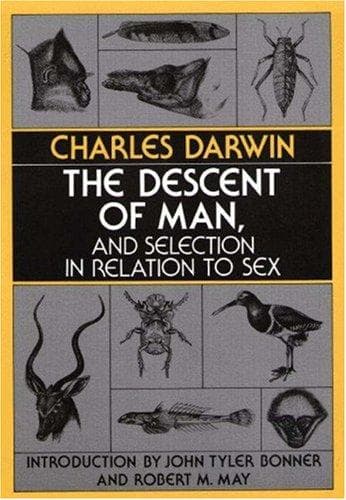
The Descent of Man, and Selection in Relation to SexDarwin, Charles
History
The Descent of Man, and Selection in Relation to Sex
Darwin, Charles
Evolution (Biology); Human beings -- Origin; Sex differences; Sexual dimorphism (Animals); Sexual selection in animals
When variations occur late in life in one sex, and are transmitted to
the same sex at the same age, the other sex and the young are left
unmodified. When they occur late in life, but are transmitted to both
sexes at the same age, the young alone are left unmodified. Variations,
however, may occur at any period of life in one sex or in both, and be
transmitted to both sexes at all ages, and then all the individuals of
the species are similarly modified. In the following chapters it will
be seen that all these cases frequently occur in nature.
Sexual selection can never act on any animal before the age for
reproduction arrives. From the great eagerness of the male it has
generally acted on this sex and not on the females. The males have thus
become provided with weapons for fighting with their rivals, with
organs for discovering and securely holding the female, and for
exciting or charming her. When the sexes differ in these respects, it
is also, as we have seen, an extremely general law that the adult male
differs more or less from the young male; and we may conclude from this
fact that the successive variations, by which the adult male became
modified, did not generally occur much before the age for reproduction.
Whenever some or many of the variations occurred early in life, the
young males would partake more or less of the characters of the adult
males; and differences of this kind between the old and young males may
be observed in many species of animals.
It is probable that young male animals have often tended to vary in a
manner which would not only have been of no use to them at an early
age, but would have been actually injurious—as by acquiring bright
colours, which would render them conspicuous to their enemies, or by
acquiring structures, such as great horns, which would expend much
vital force in their development. Variations of this kind occurring in
the young males would almost certainly be eliminated through natural
selection. With the adult and experienced males, on the other hand, the
advantages derived from the acquisition of such characters, would more
than counterbalance some exposure to danger, and some loss of vital
force.
Public-domain text, read in full here on John Shaqi.
Reviews
Reviews
No reviews yet
Be the first to share your thoughts on this work.
Elsewhere in the archive
Join the Discussion
Join the discussion
Sign in to leave a comment or review.
Sign InorCreate an account