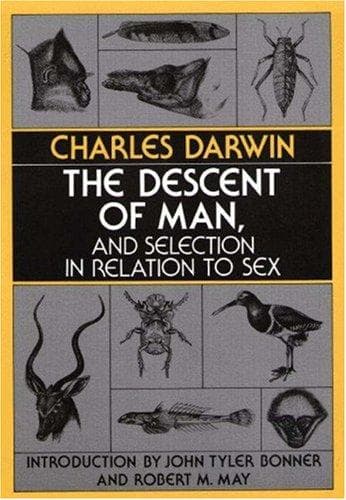
The Descent of Man, and Selection in Relation to SexDarwin, Charles
History
The Descent of Man, and Selection in Relation to Sex
Darwin, Charles
Evolution (Biology); Human beings -- Origin; Sex differences; Sexual dimorphism (Animals); Sexual selection in animals
Of mammalia in a state of nature I have been able to learn very little.
In regard to the common rat, I have received conflicting statements.
Mr. R. Elliot, of Laighwood, informs me that a rat-catcher assured him
that he had always found the males in great excess, even with the young
in the nest. In consequence of this, Mr. Elliot himself subsequently
examined some hundred old ones, and found the statement true. Mr. F.
Buckland has bred a large number of white rats, and he also believes
that the males greatly exceed the females. In regard to Moles, it is
said that “the males are much more numerous than the females” (60.
Bell, ‘History of British Quadrupeds,’ p. 100.): and as the catching of
these animals is a special occupation, the statement may perhaps be
trusted. Sir A. Smith, in describing an antelope of S. Africa (61.
‘Illustrations of the Zoology of S. Africa,’ 1849, pl. 29.) (Kobus
ellipsiprymnus), remarks, that in the herds of this and other species,
the males are few in number compared with the females: the natives
believe that they are born in this proportion; others believe that the
younger males are expelled from the herds, and Sir A. Smith says, that
though he has himself never seen herds consisting of young males alone,
others affirm that this does occur. It appears probable that the young
when expelled from the herd, would often fall a prey to the many beasts
of prey of the country.
BIRDS.
With respect to the FOWL, I have received only one account, namely,
that out of 1001 chickens of a highly-bred stock of Cochins, reared
during eight years by Mr. Stretch, 487 proved males and 514 females;
i.e., as 94.7 to 100. In regard to domestic pigeons there is good
evidence either that the males are produced in excess, or that they
live longer; for these birds invariably pair, and single males, as Mr.
Tegetmeier informs me, can always be purchased cheaper than females.
Usually the two birds reared from the two eggs laid in the same nest
are a male and a female; but Mr. Harrison Weir, who has been so large a
breeder, says that he has often bred two cocks from the same nest, and
seldom two hens; moreover, the hen is generally the weaker of the two,
and more liable to perish.
Public-domain text, read in full here on John Shaqi.
Reviews
Reviews
No reviews yet
Be the first to share your thoughts on this work.
Elsewhere in the archive
Join the Discussion
Join the discussion
Sign in to leave a comment or review.
Sign InorCreate an account