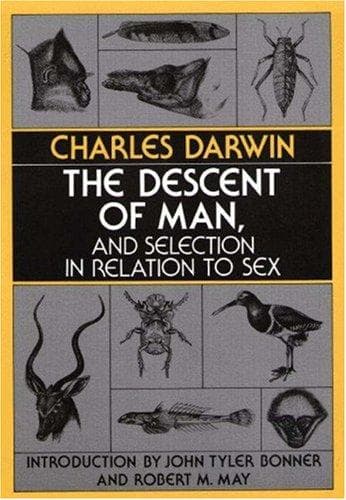
The Descent of Man, and Selection in Relation to SexDarwin, Charles
History
The Descent of Man, and Selection in Relation to Sex
Darwin, Charles
Evolution (Biology); Human beings -- Origin; Sex differences; Sexual dimorphism (Animals); Sexual selection in animals
With respect to birds in a state of nature, Mr. Gould and others (62.
Brehm (‘Thierleben,’ B. iv. s. 990) comes to the same conclusion.) are
convinced that the males are generally the more numerous; and as the
young males of many species resemble the females, the latter would
naturally appear to be the more numerous. Large numbers of pheasants
are reared by Mr. Baker of Leadenhall from eggs laid by wild birds, and
he informs Mr. Jenner Weir that four or five males to one female are
generally produced. An experienced observer remarks (63. On the
authority of L. Lloyd, ‘Game Birds of Sweden,’ 1867, pp. 12, 132.),
that in Scandinavia the broods of the capercailzie and black-cock
contain more males than females; and that with the Dal-ripa (a kind of
ptarmigan) more males than females attend the leks or places of
courtship; but this latter circumstance is accounted for by some
observers by a greater number of hen birds being killed by vermin. From
various facts given by White of Selborne (64. ‘Nat. Hist. of Selborne,’
letter xxix. edit. of 1825, vol. i. p. 139.), it seems clear that the
males of the partridge must be in considerable excess in the south of
England; and I have been assured that this is the case in Scotland. Mr.
Weir on enquiring from the dealers, who receive at certain seasons
large numbers of ruffs (Machetes pugnax), was told that the males are
much the more numerous. This same naturalist has also enquired for me
from the birdcatchers, who annually catch an astonishing number of
various small species alive for the London market, and he was
unhesitatingly answered by an old and trustworthy man, that with the
chaffinch the males are in large excess: he thought as high as 2 males
to 1 female, or at least as high as 5 to 3. (65. Mr. Jenner Weir
received similar information, on making enquiries during the following
year. To shew the number of living chaffinches caught, I may mention
that in 1869 there was a match between two experts, and one man caught
in a day 62, and another 40, male chaffinches. The greatest number ever
caught by one man in a single day was 70.) The males of the blackbird,
he likewise maintained, were by far the more numerous, whether caught
by traps or by netting at night. These statements may apparently be
trusted, because this same man said that the sexes are about equal with
the lark, the twite (Linaria montana), and goldfinch. On the other
hand, he is certain that with the common linnet, the females
preponderate greatly, but unequally during different years; during some
years he has found the females to the males as four to one. It should,
however, be borne in mind, that the chief season for catching birds
does not begin till September, so that with some species partial
migrations may have begun, and the flocks at this period often consist
of hens alone. Mr. Salvin paid particular attention to the sexes of the
humming-birds in Central America, and is convinced that with most of
Public-domain text, read in full here on John Shaqi.
Reviews
Reviews
No reviews yet
Be the first to share your thoughts on this work.
Elsewhere in the archive
Join the Discussion
Join the discussion
Sign in to leave a comment or review.
Sign InorCreate an account