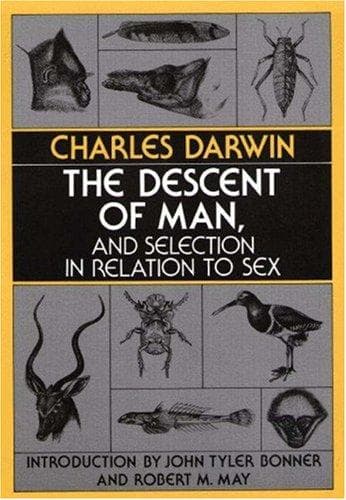
The Descent of Man, and Selection in Relation to SexDarwin, Charles
History
The Descent of Man, and Selection in Relation to Sex
Darwin, Charles
Evolution (Biology); Human beings -- Origin; Sex differences; Sexual dimorphism (Animals); Sexual selection in animals
The ‘Field’ newspaper, June
29, 1867.) This disproportion, no doubt, can be accounted for in part,
but whether wholly is doubtful, by the males ascending the rivers
before the females. Mr. F. Buckland remarks in regard to trout, that
“it is a curious fact that the males preponderate very largely in
number over the females. It INVARIABLY happens that when the first rush
of fish is made to the net, there will be at least seven or eight males
to one female found captive. I cannot quite account for this; either
the males are more numerous than the females, or the latter seek safety
by concealment rather than flight.” He then adds, that by carefully
searching the banks sufficient females for obtaining ova can be found.
(72. ‘Land and Water,’ 1868, p. 41.) Mr. H. Lee informs me that out of
212 trout, taken for this purpose in Lord Portsmouth’s park, 150 were
males and 62 females.
The males of the Cyprinidae likewise seem to be in excess; but several
members of this Family, viz., the carp, tench, bream and minnow, appear
regularly to follow the practice, rare in the animal kingdom, of
polyandry; for the female whilst spawning is always attended by two
males, one on each side, and in the case of the bream by three or four
males. This fact is so well known, that it is always recommended to
stock a pond with two male tenches to one female, or at least with
three males to two females. With the minnow, an excellent observer
states, that on the spawning-beds the males are ten times as numerous
as the females; when a female comes amongst the males, “she is
immediately pressed closely by a male on each side; and when they have
been in that situation for a time, are superseded by other two males.”
(73. Yarrell, ‘Hist. British Fishes,’ vol. i. 1826, p. 307; on the
Cyprinus carpio, p. 331; on the Tinca vulgaris, p. 331; on the Abramis
brama, p. 336. See, for the minnow (Leuciscus phoxinus), ‘Loudon’s
Magazine of Natural History,’ vol. v. 1832, p. 682.)
INSECTS.
In this great Class, the Lepidoptera almost alone afford means for
judging of the proportional numbers of the sexes; for they have been
collected with special care by many good observers, and have been
largely bred from the egg or caterpillar state. I had hoped that some
breeders of silk-moths might have kept an exact record, but after
writing to France and Italy, and consulting various treatises, I cannot
find that this has ever been done. The general opinion appears to be
that the sexes are nearly equal, but in Italy, as I hear from Professor
Canestrini, many breeders are convinced that the females are produced
in excess. This same naturalist, however, informs me, that in the two
yearly broods of the Ailanthus silk-moth (Bombyx cynthia), the males
greatly preponderate in the first, whilst in the second the two sexes
are nearly equal, or the females rather in excess.
Public-domain text, read in full here on John Shaqi.
Reviews
Reviews
No reviews yet
Be the first to share your thoughts on this work.
Elsewhere in the archive
Join the Discussion
Join the discussion
Sign in to leave a comment or review.
Sign InorCreate an account