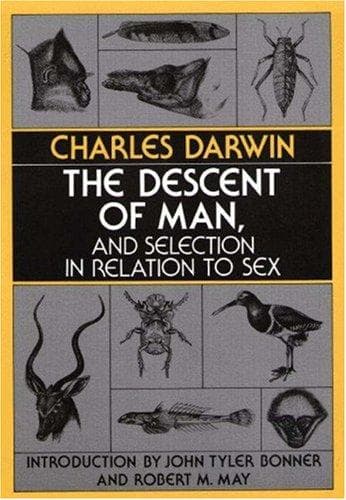
The Descent of Man, and Selection in Relation to SexDarwin, Charles
History
The Descent of Man, and Selection in Relation to Sex
Darwin, Charles
Evolution (Biology); Human beings -- Origin; Sex differences; Sexual dimorphism (Animals); Sexual selection in animals
the species the males are in excess; thus one year he procured 204
specimens belonging to ten species, and these consisted of 166 males
and of only 38 females. With two other species the females were in
excess: but the proportions apparently vary either during different
seasons or in different localities; for on one occasion the males of
Campylopterus hemileucurus were to the females as 5 to 2, and on
another occasion (66. ‘Ibis,’ vol. ii. p. 260, as quoted in Gould’s
‘Trochilidae,’ 1861, p. 52. For the foregoing proportions, I am
indebted to Mr. Salvin for a table of his results.) in exactly the
reversed ratio. As bearing on this latter point, I may add, that Mr.
Powys found in Corfu and Epirus the sexes of the chaffinch keeping
apart, and “the females by far the most numerous”; whilst in Palestine
Mr. Tristram found “the male flocks appearing greatly to exceed the
female in number.” (67. ‘Ibis,’ 1860, p. 137; and 1867, p. 369.) So
again with the Quiscalus major, Mr. G. Taylor says, that in Florida
there were “very few females in proportion to the males,” (68. ‘Ibis,’
1862, p. 187.) whilst in Honduras the proportion was the other way, the
species there having the character of a polygamist.
FISH.
With fish the proportional numbers of the sexes can be ascertained only
by catching them in the adult or nearly adult state; and there are many
difficulties in arriving at any just conclusion. (69. Leuckart quotes
Bloch (Wagner, ‘Handwörterbuch der Phys.’ B. iv. 1853, s. 775), that
with fish there are twice as many males as females.) Infertile females
might readily be mistaken for males, as Dr. Gunther has remarked to me
in regard to trout. With some species the males are believed to die
soon after fertilising the ova. With many species the males are of much
smaller size than the females, so that a large number of males would
escape from the same net by which the females were caught. M.
Carbonnier (70. Quoted in the ‘Farmer,’ March 18, 1869, p. 369.), who
has especially attended to the natural history of the pike (Esox
lucius), states that many males, owing to their small size, are
devoured by the larger females; and he believes that the males of
almost all fish are exposed from this same cause to greater danger than
the females. Nevertheless, in the few cases in which the proportional
numbers have been actually observed, the males appear to be largely in
excess. Thus Mr. R. Buist, the superintendent of the Stormontfield
experiments, says that in 1865, out of 70 salmon first landed for the
purpose of obtaining the ova, upwards of 60 were males. In 1867 he
again “calls attention to the vast disproportion of the males to the
females. We had at the outset at least ten males to one female.”
Afterwards females sufficient for obtaining ova were procured. He adds,
“from the great proportion of the males, they are constantly fighting
and tearing each other on the spawning-beds.” (71. ‘The Stormontfield
Piscicultural Experiments,’ 1866, p. 23.
Public-domain text, read in full here on John Shaqi.
Reviews
Reviews
No reviews yet
Be the first to share your thoughts on this work.
Elsewhere in the archive
Join the Discussion
Join the discussion
Sign in to leave a comment or review.
Sign InorCreate an account