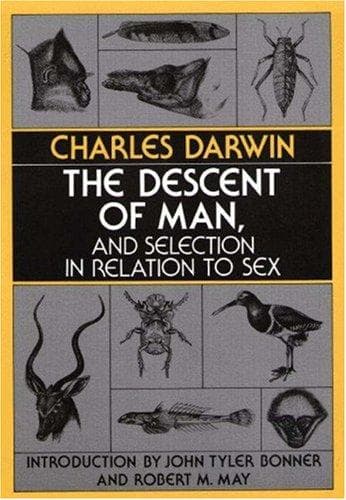
The Descent of Man, and Selection in Relation to SexDarwin, Charles
History
The Descent of Man, and Selection in Relation to Sex
Darwin, Charles
Evolution (Biology); Human beings -- Origin; Sex differences; Sexual dimorphism (Animals); Sexual selection in animals
The manner in which the males of certain moths congregate in
extraordinary numbers round a single female, apparently indicates a
great excess of males, though this fact may perhaps be accounted for by
the earlier emergence of the males from their cocoons. Mr. Stainton
informs me that from twelve to twenty males, may often be seen
congregated round a female Elachista rufocinerea. It is well known that
if a virgin Lasiocampa quercus or Saturnia carpini be exposed in a
cage, vast numbers of males collect round her, and if confined in a
room will even come down the chimney to her. Mr. Doubleday believes
that he has seen from fifty to a hundred males of both these species
attracted in the course of a single day by a female in confinement. In
the Isle of Wight Mr. Trimen exposed a box in which a female of the
Lasiocampa had been confined on the previous day, and five males soon
endeavoured to gain admittance. In Australia, Mr. Verreaux, having
placed the female of a small Bombyx in a box in his pocket, was
followed by a crowd of males, so that about 200 entered the house with
him. (81. Blanchard, ‘Metamorphoses, Moeurs des Insectes,’ 1868, pp.
225-226.)
Mr. Doubleday has called my attention to M. Staudinger’s (82.
‘Lepidopteren-Doubletten Liste,’ Berlin, No. x. 1866.) list of
Lepidoptera, which gives the prices of the males and females of 300
species or well-marked varieties of butterflies (Rhopalocera). The
prices for both sexes of the very common species are of course the
same; but in 114 of the rarer species they differ; the males being in
all cases, excepting one, the cheaper. On an average of the prices of
the 113 species, the price of the male to that of the female is as 100
to 149; and this apparently indicates that inversely the males exceed
the females in the same proportion. About 2000 species or varieties of
moths (Heterocera) are catalogued, those with wingless females being
here excluded on account of the difference in habits between the two
sexes: of these 2000 species, 141 differ in price according to sex, the
males of 130 being cheaper, and those of only 11 being dearer than the
females. The average price of the males of the 130 species, to that of
the females, is as 100 to 143. With respect to the butterflies in this
priced list, Mr. Doubleday thinks (and no man in England has had more
experience), that there is nothing in the habits of the species which
can account for the difference in the prices of the two sexes, and that
it can be accounted for only by an excess in the number of the males.
But I am bound to add that Dr. Staudinger informs me, that he is
himself of a different opinion. He thinks that the less active habits
of the females and the earlier emergence of the males will account for
his collectors securing a larger number of males than of females, and
consequently for the lower prices of the former. With respect to
specimens reared from the caterpillar-state, Dr. Staudinger believes,
Public-domain text, read in full here on John Shaqi.
Reviews
Reviews
No reviews yet
Be the first to share your thoughts on this work.
Elsewhere in the archive
Join the Discussion
Join the discussion
Sign in to leave a comment or review.
Sign InorCreate an account