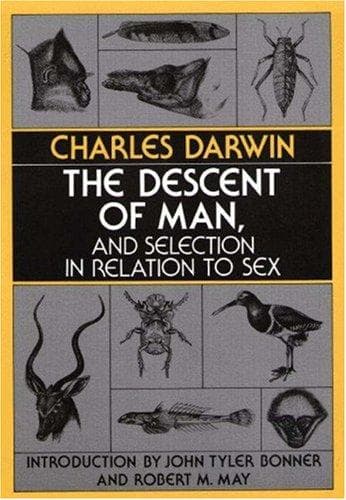
The Descent of Man, and Selection in Relation to SexDarwin, Charles
History
The Descent of Man, and Selection in Relation to Sex
Darwin, Charles
Evolution (Biology); Human beings -- Origin; Sex differences; Sexual dimorphism (Animals); Sexual selection in animals
It is manifest that man is now subject to much variability. No two
individuals of the same race are quite alike. We may compare millions
of faces, and each will be distinct. There is an equally great amount
of diversity in the proportions and dimensions of the various parts of
the body; the length of the legs being one of the most variable points.
(1. ‘Investigations in Military and Anthropological Statistics of
American Soldiers,’ by B.A. Gould, 1869, p. 256.) Although in some
quarters of the world an elongated skull, and in other quarters a short
skull prevails, yet there is great diversity of shape even within the
limits of the same race, as with the aborigines of America and South
Australia—the latter a race “probably as pure and homogeneous in blood,
customs, and language as any in existence”—and even with the
inhabitants of so confined an area as the Sandwich Islands. (2. With
respect to the “Cranial forms of the American aborigines,” see Dr.
Aitken Meigs in ‘Proc. Acad. Nat. Sci.’ Philadelphia, May 1868. On the
Australians, see Huxley, in Lyell’s ‘Antiquity of Man,’ 1863, p. 87. On
the Sandwich Islanders, Prof. J. Wyman, ‘Observations on Crania,’
Boston, 1868, p. 18.) An eminent dentist assures me that there is
nearly as much diversity in the teeth as in the features. The chief
arteries so frequently run in abnormal courses, that it has been found
useful for surgical purposes to calculate from 1040 corpses how often
each course prevails. (3. ‘Anatomy of the Arteries,’ by R. Quain.
Preface, vol. i. 1844.) The muscles are eminently variable: thus those
of the foot were found by Prof. Turner (4. ‘Transactions of the Royal
Society of Edinburgh,’ vol. xxiv. pp. 175, 189.) not to be strictly
alike in any two out of fifty bodies; and in some the deviations were
considerable. He adds, that the power of performing the appropriate
movements must have been modified in accordance with the several
deviations. Mr. J. Wood has recorded (5. ‘Proceedings Royal Society,’
1867, p. 544; also 1868, pp. 483, 524. There is a previous paper, 1866,
p. 229.) the occurrence of 295 muscular variations in thirty-six
subjects, and in another set of the same number no less than 558
variations, those occurring on both sides of the body being only
reckoned as one. In the last set, not one body out of the thirty-six
was “found totally wanting in departures from the standard descriptions
of the muscular system given in anatomical text books.” A single body
presented the extraordinary number of twenty-five distinct
abnormalities. The same muscle sometimes varies in many ways: thus
Prof. Macalister describes (6. ‘Proc. R. Irish Academy,’ vol. x. 1868,
p. 141.) no less than twenty distinct variations in the palmaris
accessorius.
Public-domain text, read in full here on John Shaqi.
Reviews
Reviews
No reviews yet
Be the first to share your thoughts on this work.
Join the Discussion
Join the discussion
Sign in to leave a comment or review.
Sign InorCreate an account