The Descent of Man, and Selection in Relation to Sex — John Shaqi
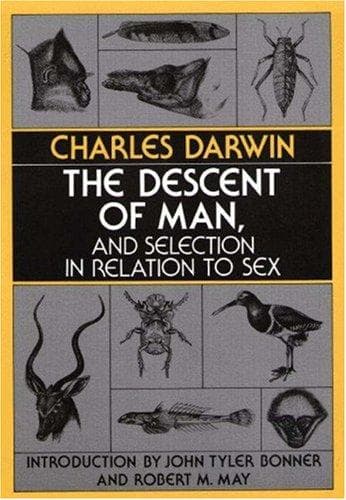
The Descent of Man, and Selection in Relation to SexDarwin, Charles
History
The Descent of Man, and Selection in Relation to Sex
Darwin, Charles
Evolution (Biology); Human beings -- Origin; Sex differences; Sexual dimorphism (Animals); Sexual selection in animals
The Grecian poet, Theognis, who lived 550
B.C., clearly saw how important selection, if carefully applied, would
be for the improvement of mankind. He saw, likewise, that wealth often
checks the proper action of sexual selection. He thus writes:
“With kine and horses, Kurnus! we proceed
By reasonable rules, and choose a breed
For profit and increase, at any price:
Of a sound stock, without defect or vice.
But, in the daily matches that we make,
The price is everything: for money’s sake,
Men marry: women are in marriage given
The churl or ruffian, that in wealth has thriven,
May match his offspring with the proudest race:
Thus everything is mix’d, noble and base!
If then in outward manner, form, and mind,
You find us a degraded, motley kind,
Wonder no more, my friend! the cause is plain,
And to lament the consequence is vain.”
(The Works of J. Hookham Frere, vol. ii. 1872, p. 334.))
If we consider all the races of man as forming a single species, his
range is enormous; but some separate races, as the Americans and
Polynesians, have very wide ranges. It is a well-known law that
widely-ranging species are much more variable than species with
restricted ranges; and the variability of man may with more truth be
compared with that of widely-ranging species, than with that of
domesticated animals.
Not only does variability appear to be induced in man and the lower
animals by the same general causes, but in both the same parts of the
body are affected in a closely analogous manner. This has been proved
in such full detail by Godron and Quatrefages, that I need here only
refer to their works. (14. Godron, ‘De l’Espèce,’ 1859, tom. ii. livre
3. Quatrefages, ‘Unité de l’Espèce Humaine,’ 1861. Also Lectures on
Anthropology, given in the ‘Revue des Cours Scientifiques,’ 1866-1868.)
Monstrosities, which graduate into slight variations, are likewise so
similar in man and the lower animals, that the same classification and
the same terms can be used for both, as has been shewn by Isidore
Geoffroy St.-Hilaire. (15. ‘Hist. Gen. et Part. des Anomalies de
l’Organisation,’ in three volumes, tom. i. 1832.) In my work on the
variation of domestic animals, I have attempted to arrange in a rude
fashion the laws of variation under the following heads:—The direct and
definite action of changed conditions, as exhibited by all or nearly
all the individuals of the same species, varying in the same manner
under the same circumstances. The effects of the long-continued use or
disuse of parts. The cohesion of homologous parts. The variability of
multiple parts. Compensation of growth; but of this law I have found no
good instance in the case of man. The effects of the mechanical
pressure of one part on another; as of the pelvis on the cranium of the
infant in the womb. Arrests of development, leading to the diminution
or suppression of parts. The reappearance of long-lost characters
through reversion.
Public-domain text, read in full here on John Shaqi.
Reviews
Reviews
No reviews yet
Be the first to share your thoughts on this work.
Join the Discussion
Join the discussion
Sign in to leave a comment or review.
Sign InorCreate an account