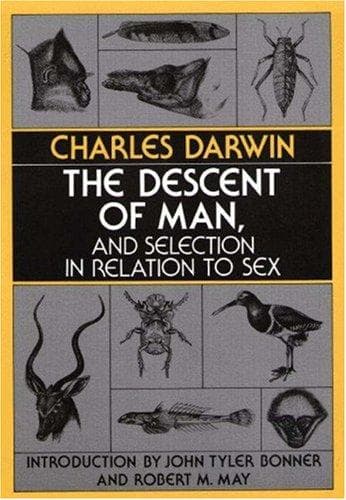
The Descent of Man, and Selection in Relation to SexDarwin, Charles
History
The Descent of Man, and Selection in Relation to Sex
Darwin, Charles
Evolution (Biology); Human beings -- Origin; Sex differences; Sexual dimorphism (Animals); Sexual selection in animals
It is, as I can now see, probable that all organic beings, including
man, possess peculiarities of structure, which neither are now, nor
were formerly of any service to them, and which, therefore, are of no
physiological importance. We know not what produces the numberless
slight differences between the individuals of each species, for
reversion only carries the problem a few steps backwards, but each
peculiarity must have had its efficient cause. If these causes,
whatever they may be, were to act more uniformly and energetically
during a lengthened period (and against this no reason can be
assigned), the result would probably be not a mere slight individual
difference, but a well-marked and constant modification, though one of
no physiological importance. Changed structures, which are in no way
beneficial, cannot be kept uniform through natural selection, though
the injurious will be thus eliminated. Uniformity of character would,
however, naturally follow from the assumed uniformity of the exciting
causes, and likewise from the free intercrossing of many individuals.
During successive periods, the same organism might in this manner
acquire successive modifications, which would be transmitted in a
nearly uniform state as long as the exciting causes remained the same
and there was free intercrossing. With respect to the exciting causes
we can only say, as when speaking of so-called spontaneous variations,
that they relate much more closely to the constitution of the varying
organism, than to the nature of the conditions to which it has been
subjected.
—CONCLUSION—
In this chapter we have seen that as man at the present day is liable,
like every other animal, to multiform individual differences or slight
variations, so no doubt were the early progenitors of man; the
variations being formerly induced by the same general causes, and
governed by the same general and complex laws as at present. As all
animals tend to multiply beyond their means of subsistence, so it must
have been with the progenitors of man; and this would inevitably lead
to a struggle for existence and to natural selection. The latter
process would be greatly aided by the inherited effects of the
increased use of parts, and these two processes would incessantly react
on each other. It appears, also, as we shall hereafter see, that
various unimportant characters have been acquired by man through sexual
selection. An unexplained residuum of change must be left to the
assumed uniform action of those unknown agencies, which occasionally
induce strongly marked and abrupt deviations of structure in our
domestic productions.
Public-domain text, read in full here on John Shaqi.
Reviews
Reviews
No reviews yet
Be the first to share your thoughts on this work.
Elsewhere in the archive
Join the Discussion
Join the discussion
Sign in to leave a comment or review.
Sign InorCreate an account