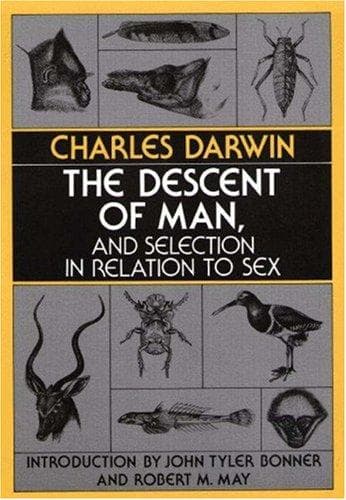
The Descent of Man, and Selection in Relation to SexDarwin, Charles
History
The Descent of Man, and Selection in Relation to Sex
Darwin, Charles
Evolution (Biology); Human beings -- Origin; Sex differences; Sexual dimorphism (Animals); Sexual selection in animals
Judging from the habits of savages and of the greater number of the
Quadrumana, primeval men, and even their ape-like progenitors, probably
lived in society. With strictly social animals, natural selection
sometimes acts on the individual, through the preservation of
variations which are beneficial to the community. A community which
includes a large number of well-endowed individuals increases in
number, and is victorious over other less favoured ones; even although
each separate member gains no advantage over the others of the same
community. Associated insects have thus acquired many remarkable
structures, which are of little or no service to the individual, such
as the pollen-collecting apparatus, or the sting of the worker-bee, or
the great jaws of soldier-ants. With the higher social animals, I am
not aware that any structure has been modified solely for the good of
the community, though some are of secondary service to it. For
instance, the horns of ruminants and the great canine teeth of baboons
appear to have been acquired by the males as weapons for sexual strife,
but they are used in defence of the herd or troop. In regard to certain
mental powers the case, as we shall see in the fifth chapter, is wholly
different; for these faculties have been chiefly, or even exclusively,
gained for the benefit of the community, and the individuals thereof
have at the same time gained an advantage indirectly.
It has often been objected to such views as the foregoing, that man is
one of the most helpless and defenceless creatures in the world; and
that during his early and less well-developed condition, he would have
been still more helpless. The Duke of Argyll, for instance, insists
(96. ‘Primeval Man,’ 1869, p. 66.) that “the human frame has diverged
from the structure of brutes, in the direction of greater physical
helplessness and weakness. That is to say, it is a divergence which of
all others it is most impossible to ascribe to mere natural selection.”
He adduces the naked and unprotected state of the body, the absence of
great teeth or claws for defence, the small strength and speed of man,
and his slight power of discovering food or of avoiding danger by
smell. To these deficiencies there might be added one still more
serious, namely, that he cannot climb quickly, and so escape from
enemies. The loss of hair would not have been a great injury to the
inhabitants of a warm country. For we know that the unclothed Fuegians
can exist under a wretched climate. When we compare the defenceless
state of man with that of apes, we must remember that the great canine
teeth with which the latter are provided, are possessed in their full
development by the males alone, and are chiefly used by them for
fighting with their rivals; yet the females, which are not thus
provided, manage to survive.
Public-domain text, read in full here on John Shaqi.
Reviews
Reviews
No reviews yet
Be the first to share your thoughts on this work.
Elsewhere in the archive
Join the Discussion
Join the discussion
Sign in to leave a comment or review.
Sign InorCreate an account