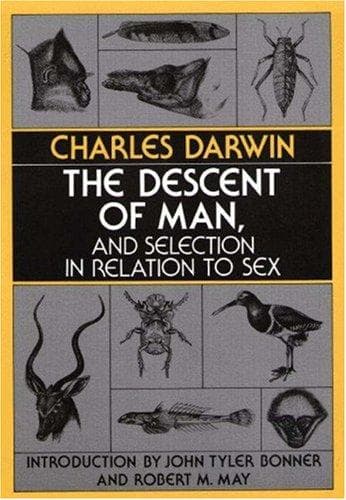
The Descent of Man, and Selection in Relation to SexDarwin, Charles
History
The Descent of Man, and Selection in Relation to Sex
Darwin, Charles
Evolution (Biology); Human beings -- Origin; Sex differences; Sexual dimorphism (Animals); Sexual selection in animals
The fewness and the comparative simplicity of the instincts in the
higher animals are remarkable in contrast with those of the lower
animals. Cuvier maintained that instinct and intelligence stand in an
inverse ratio to each other; and some have thought that the
intellectual faculties of the higher animals have been gradually
developed from their instincts. But Pouchet, in an interesting essay
(2. ‘L’Instinct chez les Insectes,’ ‘Revue des Deux Mondes,’ Feb. 1870,
p. 690.), has shewn that no such inverse ratio really exists. Those
insects which possess the most wonderful instincts are certainly the
most intelligent. In the vertebrate series, the least intelligent
members, namely fishes and amphibians, do not possess complex
instincts; and amongst mammals the animal most remarkable for its
instincts, namely the beaver, is highly intelligent, as will be
admitted by every one who has read Mr. Morgan’s excellent work. (3.
‘The American Beaver and His Works,’ 1868.)
Although the first dawnings of intelligence, according to Mr. Herbert
Spencer (4. ‘The Principles of Psychology,’ 2nd edit., 1870, pp.
418-443.), have been developed through the multiplication and
co-ordination of reflex actions, and although many of the simpler
instincts graduate into reflex actions, and can hardly be distinguished
from them, as in the case of young animals sucking, yet the more
complex instincts seem to have originated independently of
intelligence. I am, however, very far from wishing to deny that
instinctive actions may lose their fixed and untaught character, and be
replaced by others performed by the aid of the free will. On the other
hand, some intelligent actions, after being performed during several
generations, become converted into instincts and are inherited, as when
birds on oceanic islands learn to avoid man. These actions may then be
said to be degraded in character, for they are no longer performed
through reason or from experience. But the greater number of the more
complex instincts appear to have been gained in a wholly different
manner, through the natural selection of variations of simpler
instinctive actions. Such variations appear to arise from the same
unknown causes acting on the cerebral organisation, which induce slight
variations or individual differences in other parts of the body; and
these variations, owing to our ignorance, are often said to arise
spontaneously. We can, I think, come to no other conclusion with
respect to the origin of the more complex instincts, when we reflect on
the marvellous instincts of sterile worker-ants and bees, which leave
no offspring to inherit the effects of experience and of modified
habits.
Public-domain text, read in full here on John Shaqi.
Reviews
Reviews
No reviews yet
Be the first to share your thoughts on this work.
Elsewhere in the archive
Join the Discussion
Join the discussion
Sign in to leave a comment or review.
Sign InorCreate an account