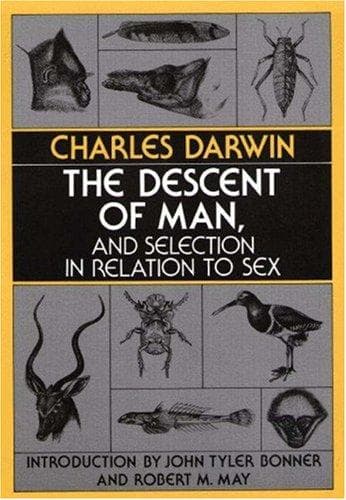
The Descent of Man, and Selection in Relation to SexDarwin, Charles
History
The Descent of Man, and Selection in Relation to Sex
Darwin, Charles
Evolution (Biology); Human beings -- Origin; Sex differences; Sexual dimorphism (Animals); Sexual selection in animals
Although, as we learn from the above-mentioned insects and the beaver,
a high degree of intelligence is certainly compatible with complex
instincts, and although actions, at first learnt voluntarily can soon
through habit be performed with the quickness and certainty of a reflex
action, yet it is not improbable that there is a certain amount of
interference between the development of free intelligence and of
instinct,—which latter implies some inherited modification of the
brain. Little is known about the functions of the brain, but we can
perceive that as the intellectual powers become highly developed, the
various parts of the brain must be connected by very intricate channels
of the freest intercommunication; and as a consequence each separate
part would perhaps tend to be less well fitted to answer to particular
sensations or associations in a definite and inherited—that is
instinctive—manner. There seems even to exist some relation between a
low degree of intelligence and a strong tendency to the formation of
fixed, though not inherited habits; for as a sagacious physician
remarked to me, persons who are slightly imbecile tend to act in
everything by routine or habit; and they are rendered much happier if
this is encouraged.
I have thought this digression worth giving, because we may easily
underrate the mental powers of the higher animals, and especially of
man, when we compare their actions founded on the memory of past
events, on foresight, reason, and imagination, with exactly similar
actions instinctively performed by the lower animals; in this latter
case the capacity of performing such actions has been gained, step by
step, through the variability of the mental organs and natural
selection, without any conscious intelligence on the part of the animal
during each successive generation. No doubt, as Mr. Wallace has argued
(5. ‘Contributions to the Theory of Natural Selection,’ 1870, p. 212.),
much of the intelligent work done by man is due to imitation and not to
reason; but there is this great difference between his actions and many
of those performed by the lower animals, namely, that man cannot, on
his first trial, make, for instance, a stone hatchet or a canoe,
through his power of imitation. He has to learn his work by practice; a
beaver, on the other hand, can make its dam or canal, and a bird its
nest, as well, or nearly as well, and a spider its wonderful web, quite
as well (6. For the evidence on this head, see Mr. J. Traherne
Moggridge’s most interesting work, ‘Harvesting Ants and Trap-Door
Spiders,’ 1873, pp. 126, 128.), the first time it tries as when old and
experienced.
Public-domain text, read in full here on John Shaqi.
Reviews
Reviews
No reviews yet
Be the first to share your thoughts on this work.
Elsewhere in the archive
Join the Discussion
Join the discussion
Sign in to leave a comment or review.
Sign InorCreate an account