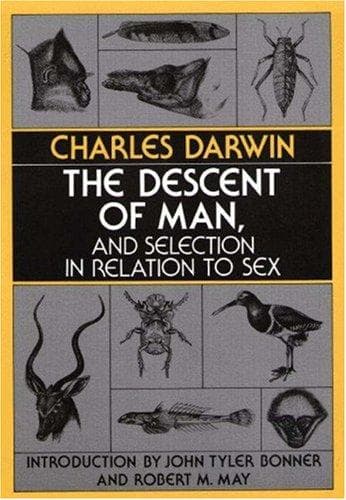
The Descent of Man, and Selection in Relation to SexDarwin, Charles
History
The Descent of Man, and Selection in Relation to Sex
Darwin, Charles
Evolution (Biology); Human beings -- Origin; Sex differences; Sexual dimorphism (Animals); Sexual selection in animals
In the agony of death a dog has been known to caress his master, and
every one has heard of the dog suffering under vivisection, who licked
the hand of the operator; this man, unless the operation was fully
justified by an increase of our knowledge, or unless he had a heart of
stone, must have felt remorse to the last hour of his life.
As Whewell (10. ‘Bridgewater Treatise,’ p. 263.) has well asked, “who
that reads the touching instances of maternal affection, related so
often of the women of all nations, and of the females of all animals,
can doubt that the principle of action is the same in the two cases?”
We see maternal affection exhibited in the most trifling details; thus
Rengger observed an American monkey (a Cebus) carefully driving away
the flies which plagued her infant; and Duvaucel saw a Hylobates
washing the faces of her young ones in a stream. So intense is the
grief of female monkeys for the loss of their young, that it invariably
caused the death of certain kinds kept under confinement by Brehm in N.
Africa. Orphan monkeys were always adopted and carefully guarded by the
other monkeys, both males and females. One female baboon had so
capacious a heart that she not only adopted young monkeys of other
species, but stole young dogs and cats, which she continually carried
about. Her kindness, however, did not go so far as to share her food
with her adopted offspring, at which Brehm was surprised, as his
monkeys always divided everything quite fairly with their own young
ones. An adopted kitten scratched this affectionate baboon, who
certainly had a fine intellect, for she was much astonished at being
scratched, and immediately examined the kitten’s feet, and without more
ado bit off the claws. (11. A critic, without any grounds (‘Quarterly
Review,’ July 1871, p. 72), disputes the possibility of this act as
described by Brehm, for the sake of discrediting my work. Therefore I
tried, and found that I could readily seize with my own teeth the sharp
little claws of a kitten nearly five weeks old.) In the Zoological
Gardens, I heard from the keeper that an old baboon (C. chacma) had
adopted a Rhesus monkey; but when a young drill and mandrill were
placed in the cage, she seemed to perceive that these monkeys, though
distinct species, were her nearer relatives, for she at once rejected
the Rhesus and adopted both of them. The young Rhesus, as I saw, was
greatly discontented at being thus rejected, and it would, like a
naughty child, annoy and attack the young drill and mandrill whenever
it could do so with safety; this conduct exciting great indignation in
the old baboon. Monkeys will also, according to Brehm, defend their
master when attacked by any one, as well as dogs to whom they are
attached, from the attacks of other dogs. But we here trench on the
subjects of sympathy and fidelity, to which I shall recur. Some of
Brehm’s monkeys took much delight in teasing a certain old dog whom
Public-domain text, read in full here on John Shaqi.
Reviews
Reviews
No reviews yet
Be the first to share your thoughts on this work.
Elsewhere in the archive
Join the Discussion
Join the discussion
Sign in to leave a comment or review.
Sign InorCreate an account