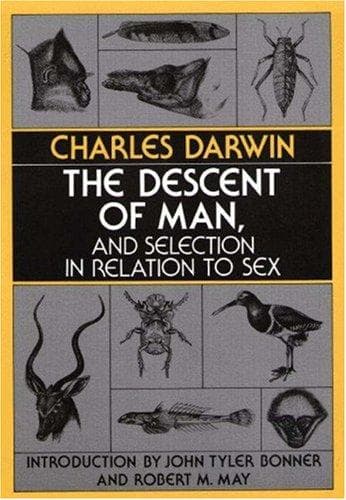
The Descent of Man, and Selection in Relation to SexDarwin, Charles
History
The Descent of Man, and Selection in Relation to Sex
Darwin, Charles
Evolution (Biology); Human beings -- Origin; Sex differences; Sexual dimorphism (Animals); Sexual selection in animals
To return to our immediate subject: the lower animals, like man,
manifestly feel pleasure and pain, happiness and misery. Happiness is
never better exhibited than by young animals, such as puppies, kittens,
lambs, etc., when playing together, like our own children. Even insects
play together, as has been described by that excellent observer, P.
Huber (7. ‘Recherches sur les Moeurs des Fourmis,’ 1810, p. 173.), who
saw ants chasing and pretending to bite each other, like so many
puppies.
The fact that the lower animals are excited by the same emotions as
ourselves is so well established, that it will not be necessary to
weary the reader by many details. Terror acts in the same manner on
them as on us, causing the muscles to tremble, the heart to palpitate,
the sphincters to be relaxed, and the hair to stand on end. Suspicion,
the offspring of fear, is eminently characteristic of most wild
animals. It is, I think, impossible to read the account given by Sir E.
Tennent, of the behaviour of the female elephants, used as decoys,
without admitting that they intentionally practise deceit, and well
know what they are about. Courage and timidity are extremely variable
qualities in the individuals of the same species, as is plainly seen in
our dogs. Some dogs and horses are ill-tempered, and easily turn sulky;
others are good-tempered; and these qualities are certainly inherited.
Every one knows how liable animals are to furious rage, and how plainly
they shew it. Many, and probably true, anecdotes have been published on
the long-delayed and artful revenge of various animals. The accurate
Rengger, and Brehm (8. All the following statements, given on the
authority of these two naturalists, are taken from Rengger’s
‘Naturgesch. der Säugethiere von Paraguay,’ 1830, s. 41-57, and from
Brehm’s ‘Thierleben,’ B. i. s. 10-87.) state that the American and
African monkeys which they kept tame, certainly revenged themselves.
Sir Andrew Smith, a zoologist whose scrupulous accuracy was known to
many persons, told me the following story of which he was himself an
eye-witness; at the Cape of Good Hope an officer had often plagued a
certain baboon, and the animal, seeing him approaching one Sunday for
parade, poured water into a hole and hastily made some thick mud, which
he skilfully dashed over the officer as he passed by, to the amusement
of many bystanders. For long afterwards the baboon rejoiced and
triumphed whenever he saw his victim.
The love of a dog for his master is notorious; as an old writer
quaintly says (9. Quoted by Dr. Lauder Lindsay, in his ‘Physiology of
Mind in the Lower Animals,’ ‘Journal of Mental Science,’ April 1871, p.
38.), “A dog is the only thing on this earth that luvs you more than he
luvs himself.”
Public-domain text, read in full here on John Shaqi.
Reviews
Reviews
No reviews yet
Be the first to share your thoughts on this work.
Elsewhere in the archive
Join the Discussion
Join the discussion
Sign in to leave a comment or review.
Sign InorCreate an account