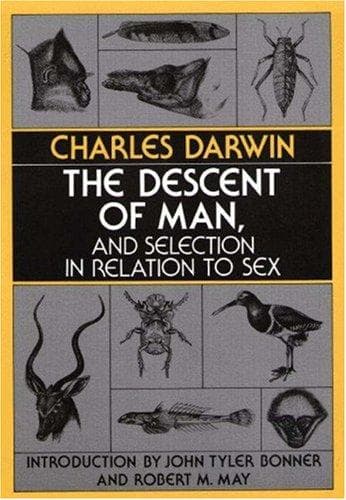
The Descent of Man, and Selection in Relation to SexDarwin, Charles
History
The Descent of Man, and Selection in Relation to Sex
Darwin, Charles
Evolution (Biology); Human beings -- Origin; Sex differences; Sexual dimorphism (Animals); Sexual selection in animals
I have seen, as I daresay have others, that when a small object is
thrown on the ground beyond the reach of one of the elephants in the
Zoological Gardens, he blows through his trunk on the ground beyond the
object, so that the current reflected on all sides may drive the object
within his reach. Again a well-known ethnologist, Mr. Westropp, informs
me that he observed in Vienna a bear deliberately making with his paw a
current in some water, which was close to the bars of his cage, so as
to draw a piece of floating bread within his reach. These actions of
the elephant and bear can hardly be attributed to instinct or inherited
habit, as they would be of little use to an animal in a state of
nature. Now, what is the difference between such actions, when
performed by an uncultivated man, and by one of the higher animals?
The savage and the dog have often found water at a low level, and the
coincidence under such circumstances has become associated in their
minds. A cultivated man would perhaps make some general proposition on
the subject; but from all that we know of savages it is extremely
doubtful whether they would do so, and a dog certainly would not. But a
savage, as well as a dog, would search in the same way, though
frequently disappointed; and in both it seems to be equally an act of
reason, whether or not any general proposition on the subject is
consciously placed before the mind. (25. Prof. Huxley has analysed with
admirable clearness the mental steps by which a man, as well as a dog,
arrives at a conclusion in a case analogous to that given in my text.
See his article, ‘Mr. Darwin’s Critics,’ in the ‘Contemporary Review,’
Nov. 1871, p. 462, and in his ‘Critiques and Essays,’ 1873, p. 279.)
The same would apply to the elephant and the bear making currents in
the air or water. The savage would certainly neither know nor care by
what law the desired movements were effected; yet his act would be
guided by a rude process of reasoning, as surely as would a philosopher
in his longest chain of deductions. There would no doubt be this
difference between him and one of the higher animals, that he would
take notice of much slighter circumstances and conditions, and would
observe any connection between them after much less experience, and
this would be of paramount importance. I kept a daily record of the
actions of one of my infants, and when he was about eleven months old,
and before he could speak a single word, I was continually struck with
the greater quickness, with which all sorts of objects and sounds were
associated together in his mind, compared with that of the most
intelligent dogs I ever knew. But the higher animals differ in exactly
the same way in this power of association from those low in the scale,
such as the pike, as well as in that of drawing inferences and of
observation.
Public-domain text, read in full here on John Shaqi.
Reviews
Reviews
No reviews yet
Be the first to share your thoughts on this work.
Elsewhere in the archive
Join the Discussion
Join the discussion
Sign in to leave a comment or review.
Sign InorCreate an account