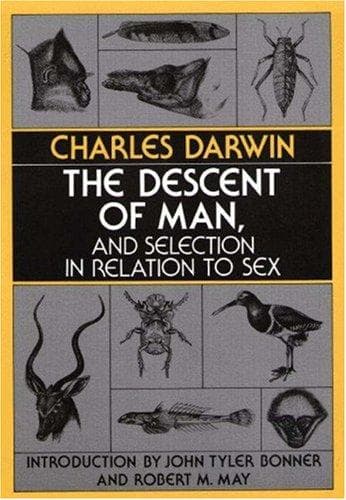
The Descent of Man, and Selection in Relation to SexDarwin, Charles
History
The Descent of Man, and Selection in Relation to Sex
Darwin, Charles
Evolution (Biology); Human beings -- Origin; Sex differences; Sexual dimorphism (Animals); Sexual selection in animals
The promptings of reason, after very short experience, are well shewn
by the following actions of American monkeys, which stand low in their
order. Rengger, a most careful observer, states that when he first gave
eggs to his monkeys in Paraguay, they smashed them, and thus lost much
of their contents; afterwards they gently hit one end against some hard
body, and picked off the bits of shell with their fingers. After
cutting themselves only ONCE with any sharp tool, they would not touch
it again, or would handle it with the greatest caution. Lumps of sugar
were often given them wrapped up in paper; and Rengger sometimes put a
live wasp in the paper, so that in hastily unfolding it they got stung;
after this had ONCE happened, they always first held the packet to
their ears to detect any movement within. (26. Mr. Belt, in his most
interesting work, ‘The Naturalist in Nicaragua,’ 1874, (p. 119),
likewise describes various actions of a tamed Cebus, which, I think,
clearly shew that this animal possessed some reasoning power.)
The following cases relate to dogs. Mr. Colquhoun (27. ‘The Moor and
the Loch,’ p. 45. Col. Hutchinson on ‘Dog Breaking,’ 1850, p. 46.)
winged two wild-ducks, which fell on the further side of a stream; his
retriever tried to bring over both at once, but could not succeed; she
then, though never before known to ruffle a feather, deliberately
killed one, brought over the other, and returned for the dead bird.
Col. Hutchinson relates that two partridges were shot at once, one
being killed, the other wounded; the latter ran away, and was caught by
the retriever, who on her return came across the dead bird; “she
stopped, evidently greatly puzzled, and after one or two trials,
finding she could not take it up without permitting the escape of the
winged bird, she considered a moment, then deliberately murdered it by
giving it a severe crunch, and afterwards brought away both together.
This was the only known instance of her ever having wilfully injured
any game.” Here we have reason though not quite perfect, for the
retriever might have brought the wounded bird first and then returned
for the dead one, as in the case of the two wild-ducks. I give the
above cases, as resting on the evidence of two independent witnesses,
and because in both instances the retrievers, after deliberation, broke
through a habit which is inherited by them (that of not killing the
game retrieved), and because they shew how strong their reasoning
faculty must have been to overcome a fixed habit.
Public-domain text, read in full here on John Shaqi.
Reviews
Reviews
No reviews yet
Be the first to share your thoughts on this work.
Elsewhere in the archive
Join the Discussion
Join the discussion
Sign in to leave a comment or review.
Sign InorCreate an account