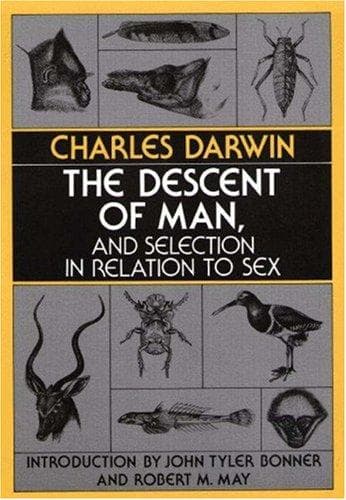
The Descent of Man, and Selection in Relation to SexDarwin, Charles
History
The Descent of Man, and Selection in Relation to Sex
Darwin, Charles
Evolution (Biology); Human beings -- Origin; Sex differences; Sexual dimorphism (Animals); Sexual selection in animals
feeling of gratitude, mystery, etc.; believes in God, or is endowed
with a conscience. I will hazard a few remarks on the more important
and interesting of these points.
Archbishop Sumner formerly maintained (31. Quoted by Sir C. Lyell,
‘Antiquity of Man,’ p. 497.) that man alone is capable of progressive
improvement. That he is capable of incomparably greater and more rapid
improvement than is any other animal, admits of no dispute; and this is
mainly due to his power of speaking and handing down his acquired
knowledge. With animals, looking first to the individual, every one who
has had any experience in setting traps, knows that young animals can
be caught much more easily than old ones; and they can be much more
easily approached by an enemy. Even with respect to old animals, it is
impossible to catch many in the same place and in the same kind of
trap, or to destroy them by the same kind of poison; yet it is
improbable that all should have partaken of the poison, and impossible
that all should have been caught in a trap. They must learn caution by
seeing their brethren caught or poisoned. In North America, where the
fur-bearing animals have long been pursued, they exhibit, according to
the unanimous testimony of all observers, an almost incredible amount
of sagacity, caution and cunning; but trapping has been there so long
carried on, that inheritance may possibly have come into play. I have
received several accounts that when telegraphs are first set up in any
district, many birds kill themselves by flying against the wires, but
that in the course of a very few years they learn to avoid this danger,
by seeing, as it would appear, their comrades killed. (32. For
additional evidence, with details, see M. Houzeau, ‘Études sur les
Facultés Mentales des Animaux,’ tom. ii. 1872, p. 147.)
If we look to successive generations, or to the race, there is no doubt
that birds and other animals gradually both acquire and lose caution in
relation to man or other enemies (33. See, with respect to birds on
oceanic islands, my ‘Journal of Researches during the Voyage of the
“Beagle,”’ 1845, p. 398. ‘Origin of Species,’ 5th ed. p. 260.); and
this caution is certainly in chief part an inherited habit or instinct,
but in part the result of individual experience. A good observer, Leroy
(34. ‘Lettres Phil. sur l’Intelligence des Animaux,’ nouvelle edit.,
1802, p. 86.), states, that in districts where foxes are much hunted,
the young, on first leaving their burrows, are incontestably much more
wary than the old ones in districts where they are not much disturbed.
Public-domain text, read in full here on John Shaqi.
Reviews
Reviews
No reviews yet
Be the first to share your thoughts on this work.
Elsewhere in the archive
Join the Discussion
Join the discussion
Sign in to leave a comment or review.
Sign InorCreate an account