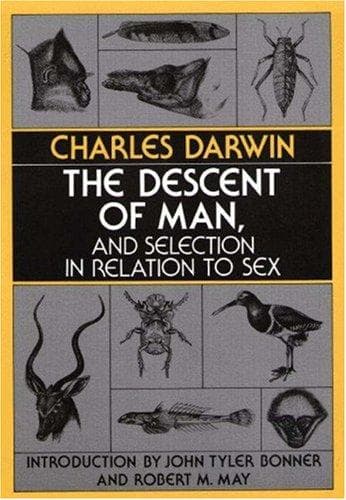
The Descent of Man, and Selection in Relation to SexDarwin, Charles
History
The Descent of Man, and Selection in Relation to Sex
Darwin, Charles
Evolution (Biology); Human beings -- Origin; Sex differences; Sexual dimorphism (Animals); Sexual selection in animals
I will conclude by quoting a remark by the illustrious Humboldt. (28.
‘Personal Narrative,’ Eng. translat., vol. iii. p. 106.) “The muleteers
in S. America say, ‘I will not give you the mule whose step is easiest,
but la mas racional,—the one that reasons best’”; and; as, he adds,
“this popular expression, dictated by long experience, combats the
system of animated machines, better perhaps than all the arguments of
speculative philosophy.” Nevertheless some writers even yet deny that
the higher animals possess a trace of reason; and they endeavour to
explain away, by what appears to be mere verbiage, (29. I am glad to
find that so acute a reasoner as Mr. Leslie Stephen (‘Darwinism and
Divinity, Essays on Free Thinking,’ 1873, p. 80), in speaking of the
supposed impassable barrier between the minds of man and the lower
animals, says, “The distinctions, indeed, which have been drawn, seem
to us to rest upon no better foundation than a great many other
metaphysical distinctions; that is, the assumption that because you can
give two things different names, they must therefore have different
natures. It is difficult to understand how anybody who has ever kept a
dog, or seen an elephant, can have any doubt as to an animal’s power of
performing the essential processes of reasoning.”) all such facts as
those above given.
It has, I think, now been shewn that man and the higher animals,
especially the Primates, have some few instincts in common. All have
the same senses, intuitions, and sensations,—similar passions,
affections, and emotions, even the more complex ones, such as jealousy,
suspicion, emulation, gratitude, and magnanimity; they practise deceit
and are revengeful; they are sometimes susceptible to ridicule, and
even have a sense of humour; they feel wonder and curiosity; they
possess the same faculties of imitation, attention, deliberation,
choice, memory, imagination, the association of ideas, and reason,
though in very different degrees. The individuals of the same species
graduate in intellect from absolute imbecility to high excellence. They
are also liable to insanity, though far less often than in the case of
man. (30. See ‘Madness in Animals,’ by Dr. W. Lauder Lindsay, in
‘Journal of Mental Science,’ July 1871.) Nevertheless, many authors
have insisted that man is divided by an insuperable barrier from all
the lower animals in his mental faculties. I formerly made a collection
of above a score of such aphorisms, but they are almost worthless, as
their wide difference and number prove the difficulty, if not the
impossibility, of the attempt. It has been asserted that man alone is
capable of progressive improvement; that he alone makes use of tools or
fire, domesticates other animals, or possesses property; that no animal
has the power of abstraction, or of forming general concepts, is
self-conscious and comprehends itself; that no animal employs language;
that man alone has a sense of beauty, is liable to caprice, has the
Public-domain text, read in full here on John Shaqi.
Reviews
Reviews
No reviews yet
Be the first to share your thoughts on this work.
Elsewhere in the archive
Join the Discussion
Join the discussion
Sign in to leave a comment or review.
Sign InorCreate an account