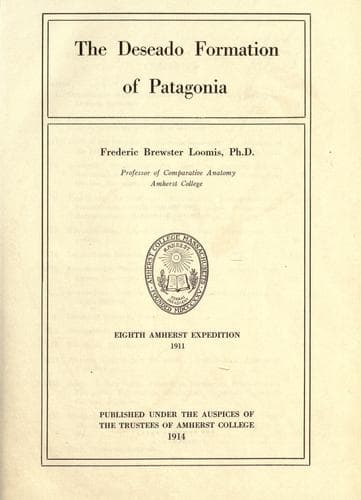
The Deseado Formation of PatagoniaLoomis, Frederic Brewster
Science
The Deseado Formation of Patagonia
Loomis, Frederic Brewster
Paleontology -- Patagonia (Argentina and Chile)
As to the age of the Deseado deposit which we worked. It is under the
Patagonian, and therefore must be as old as the Oligocene. On the
other hand it must be as young as the Eocene, lying as it does above
the Upper Cretaceous. Of the three general faunas described it is
clearly more advanced than either the Casamayor, or the Astraponotus;
so should be put as the youngest of these three. The Colpodon,
the Astrapothericulus and the Notohippus, faunas are said to be
interstratified with the Patagonian and therefore of the same age. The
amount of advancement from the Casamayor to the Deseado is considerable
and the relationships of the Deseado are fairly close with the various
genera of the Santa Cruz; so that I should put the Deseado as far up as
possible toward the Santa Cruz. The Santa Cruz is above the Patagonian,
and I think that the Deseado should be put just before the Patagonian;
that is in the Oligocene, but just what part of the Oligocene can only
be determined when the other faunas have been further studied.
CHAPTER III
THE DESEADO FAUNA
The exposure of the Deseado, which the Amherst party worked, yielded
293 specimens, each presumably representing an individual. (There were
besides these a few that were indeterminate and are not therefore
included.) The consideration of the fauna as a whole suggests certain
ideas as to the country in which the animals lived, and also certain
comparisons with the fauna of the preceding and later faunas.
The first striking feature is the presence of so many excessively
large animals, as _Asmodeus_, _Parastrapotherium_, and _Pyrotherium_,
in each case forms larger than a rhinoceros. Further than that they
are in each case the largest members of their family, even larger than
the representatives in the later Santa Cruz. This would indicate a
period in which living conditions were at a high grade, suggesting both
abundance of food and a moderate climate.
The following table will give a good idea as to the range of species,
and their relative abundance in the fauna, also a suggestion as to
the class of food they used; and from that an idea as to what sort of
country they occupied:
PER NUMBER SPECIES FOOD COUNTRY
CENT
3 Hegetotherium shumwayi
7 Prosotherium garzoni
17 Prosotherium triangulidens
1 Eutrachytherus grandis
4 Eutrachytherus spegazzinius Grass, bark Plains
and browse
1 Isoproedrium solitarium
2 Phanophilus dorsatus
4 Argyrohyrax proavus
1 Plagiarthrus clivus
14% 40 TYPOTHERIA
1 Protheosodon coniferus Grass Plains
15 Notodiaphorus crassus
6% 16 LITOPTERNA
19 Rhynchippus equinus Grass Plains
7% 19 RHYNCHIPPIDAE
Public-domain text, read in full here on John Shaqi.
Reviews
Reviews
No reviews yet
Be the first to share your thoughts on this work.
Join the Discussion
Join the discussion
Sign in to leave a comment or review.
Sign InorCreate an account