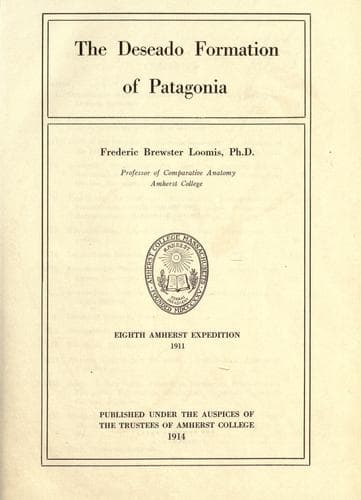
The Deseado Formation of PatagoniaLoomis, Frederic Brewster
Science
The Deseado Formation of Patagonia
Loomis, Frederic Brewster
Paleontology -- Patagonia (Argentina and Chile)
Of our fauna 11 per cent were flesh or insect eating, and for the
purpose of determining the type of country may best be omitted.
The rodents could have been either forest or open country forms.
Of the remaining 54 per cent, the typotheres, the litopternas, the
_Rhynchippidae_, the _Leontinidae_, the nesodonts and the birds (46
per cent) were distinctly adapted to live on hard ground; the other
8 per cent being evidently suited to living near a river. All 54 per
cent ate either grass or browse. The litopternas are grass eaters;
the typotheres were specialized to eat grass or bark; nesodonts,
_Leontinidae_, and _Rhynchippidae_ are grass and browse eaters. Even
the _Pyrotherium_ has a pair of gnawing tushes. The picture arising
from these considerations is a bush covered prairie, a country not
unlike the upland bush pampas of Patagonia today.
There is not an aquatic form (fish or turtle) in the whole list, so
it is evident that the stream which deposited these Deseado beds was
not abundantly inhabited. To me it looks like so many of the streams
in an arid country, dry through a considerable part of the year, and
so uninhabited. In the whole list I see nothing to indicate forests
or swamps. The arid bush covered plain alone seems to suit the
requirements.
As I see this fauna it is composed of several distinct elements,
representing different invasions and an element which arose in situ.
The reasons for the affinities expressed in the different groups will
be found in the introductory paragraphs of the systematic discussion of
each group.
The _Notungulata_, including the _Typotheria_, the _Toxodontia_, the
_Litopterna_, the _Homalodontotheria_, and the _Astrapotheria_ are
a group with apparently a common ancestry. In Patagonia they have
specialized into the various subdivisions as we find them in the
Deseado. This group was in Patagonia as early or earlier than the
Casamayor. Their relationships appear to me to be with the _Hyracoidea_
which are generally credited with originating in Africa.
The _Pyrotheria_ are related to the early elephants which also arose in
Africa, but it seems to me that this form came to Patagonia at least at
a later period, making its first appearance in the upper part of the
Astraponotus period. Ultimately the elephants and _Hyracoidea_ had a
common origin in Africa.
The _Rodentia_ are all hystricomorphs and appear in South America for
the first time in the Deseado. They also occur in the Oligocene of
Europe and the Fayum of north Africa. They never reached North America
so must have come to South America by some southern route.
The Edentata are an element of the Casamayor fauna and as there is no
evidence of their originating anywhere else it would seem that they
were indigenous to South America, where they later flourished and
developed the greatest variety and profusion of numbers.
Public-domain text, read in full here on John Shaqi.
Reviews
Reviews
No reviews yet
Be the first to share your thoughts on this work.
Join the Discussion
Join the discussion
Sign in to leave a comment or review.
Sign InorCreate an account