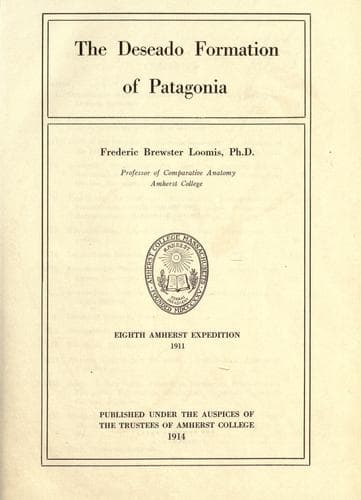
The Deseado Formation of PatagoniaLoomis, Frederic Brewster
Science
The Deseado Formation of Patagonia
Loomis, Frederic Brewster
Paleontology -- Patagonia (Argentina and Chile)
Material was found in various beds, from the Cretaceous up to the Lower
Miocene; but the major part of the fossils, and most of the facts new
to science came from the work in the Deseado Formation. The collections
from the horizon were so complete and interesting that this report
of the expedition has assumed the form of a monograph of the Deseado
Formation, otherwise known as the Pyrotherium beds.
The first work in this formation was done by Carlos Ameghino who
at various times between 1889 and 1894 collected for his brother,
Florentino Ameghino, the latter studying and describing the
collections of Carlos, whose trips covered the country from Chubut
down to the Straits of Magellan, and the various formations from the
Lower Cretaceous to the Pampean or Pleistocene. Carlos Ameghino and
his brother, Florentino, for years explored in Patagonia, going summer
after summer at their own expense, and in the meantime maintaining a
small book and stationery store in La Plata, the profits of which gave
the two brothers a living and furnished the funds for the continual
expeditions. In the back of the store was the workshop from which
came the continuous stream of knowledge in regard to these strange
faunas. One of the best pieces of work done by the brothers was the
collecting and describing of the fauna of the Pyrotherium beds the bulk
of which is contained in two papers entitled, Première Contribution à
la Connaissance de la Fauna mammalogique des Couches à Pyrotherium,
and Mammifères Crétacés de L’Argentine, Deuxième Contribution, etc.,
both published in the Boletin del Instituto Geográfico Argentino,
tomes 15 and 18 respectively. These two papers give names to most of
the forms which we found, but the genera and species are based on very
fragmentary and incomplete material. It has been a pleasure to find the
accuracy with which these descriptions were made; and our part has been
chiefly to supplement and increase the knowledge of the various forms,
and to determine from the more complete material the relationships of
these strange forms. In some cases we have been able to assemble all
the parts of the animals, and in the others to add more or less to the
completion of the knowledge of the forms. There is one peculiarity
of Ameghino’s descriptions, namely the absence of data as to the
localities where the forms were found.
About 1900 Tournier, in the interests of the Paris Museum, made a
series of expeditions (5) to Patagonia, on some of which he found a
Pyrotherium, or as he has termed it Deseado, locality just south of
the Deseado River, from which he gathered a considerable collection
which has been described by Albert Gaudry in various papers mostly in
the Annales de Paléontologie.
Public-domain text, read in full here on John Shaqi.
Reviews
Reviews
No reviews yet
Be the first to share your thoughts on this work.
Join the Discussion
Join the discussion
Sign in to leave a comment or review.
Sign InorCreate an account