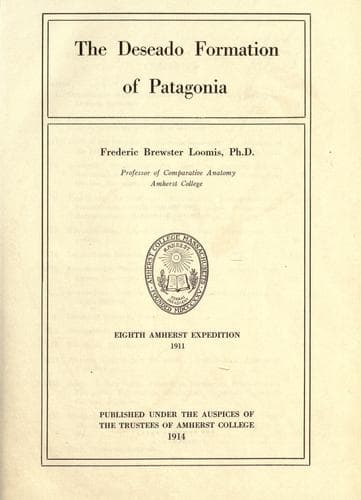
The Deseado Formation of PatagoniaLoomis, Frederic Brewster
Science
The Deseado Formation of Patagonia
Loomis, Frederic Brewster
Paleontology -- Patagonia (Argentina and Chile)
The group all have the front teeth modified into cropping or gnawing
types, which grow permanently from persistent pulps; and the back
teeth also growing through the whole or a large part of life, and
also rootless, the crowns being variously infolded to make grinding
surfaces. The skull is flattened above, and abruptly truncated behind;
the cranium being large and swollen, the facial portion broad above
and excavated on the sides. The orbits are centrally located, of
considerable size, and unbounded behind. The tympanic bulla is swollen
and may be hollow or filled with cancellous tissue. This cavity of
the tympanic is continued above and expands in the upper part of the
squamosum, making a swollen capsule on either side of the back of the
cranium. The openings of the auditory meatus are well back and in a
tubular growth of the periotic which is directed back, and upward in
an entirely characteristic manner. The strong paroccipital processes
project far below the base of the carnium. The concave palate is wide
and carried well back behind the teeth ending in two strong pterygoid
processes. The mandible is deep, especially the back portion; has
a slender coronoid process, and a small rounded articular condyle
which would seem to indicate a forward and backward motion of the
jaws. On account of the agreement with these general features, I have
placed among the _Typotheria_ the forms which Ameghino classified as
_Hyracoidea_.
While agreeing in the above general features, there is great variation
among the various forms. The first upper and lower incisor may be
greatly enlarged or of normal size. There is a tendency for the
third upper and lower incisor, the canines, and the first premolars
to be reduced and disappear, and all intermediate grades are found.
In the molars there is a regular tendency toward simplification; so
that in the upper molars of the earlier forms there is a deep inner
fold and a more moderate outer fold, either or both of which may
disappear completely, though in one series the fold seems to have been
accentuated instead of lost. The feet may be adapted to running or
hopping.
Public-domain text, read in full here on John Shaqi.
Reviews
Reviews
No reviews yet
Be the first to share your thoughts on this work.
Join the Discussion
Join the discussion
Sign in to leave a comment or review.
Sign InorCreate an account