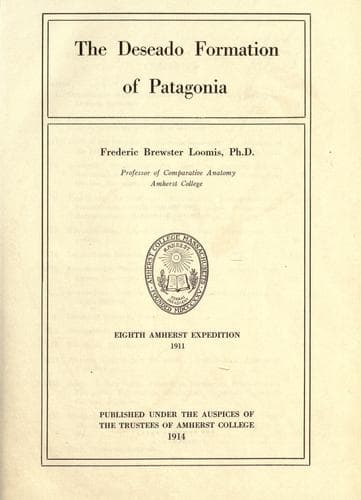
The Deseado Formation of PatagoniaLoomis, Frederic Brewster
Science
The Deseado Formation of Patagonia
Loomis, Frederic Brewster
Paleontology -- Patagonia (Argentina and Chile)
In many ways, the family suggests _Nesodontidae_, and undoubtedly
belongs to that series, if not directly ancestral. The lower molars are
distinctly of the same type as in all the other toxodonts, but show a
tendency to become hyposodont.
The following genera have been assigned by Ameghino to the family. Some
of them are based on very scant material and I have ventured to suggest
in each case what disposition I have felt to be the proper one.
=Leontinia=, the type genus, is described in detail on pages 109-115.
=Scaphops= is based on a mandibular symphysis, which is wider than
usual for _Leontinia_, and on a second upper incisor which is
compressed. The species in the genus _Leontinia_ show a marked degree
of variability, and I can see in this only individual variability, so
that I place _Scaphops_ under _Leontinia_ and _S. grypus_, as a synonym
of _L. gaudryi_.
=Steniogenium= is based on a mandibular symphysis with roots only of
the teeth. The incisors are proclivous and inc. 3 small. I consider
this also as _Leontinia_, and the species _S. sclerops_ as a synonym of
_L. oxyrhynca_, which I think is the female of _L. gaudryi_.
=Ancylocoelus= is a valid genus, differentiated by its dental formula
3 0 4 3
-------,
3 0 3 3
the loss of the upper canine and the lower canine and first premolar
distinguishing it from either _Leontinia_ or _Colpodon_.
=Rodiotherium= is based on a mandibular symphysis which would indicate
an animal with the same formula as the foregoing genus, differing only
in that lower incisor 3 is large. This, to my mind, does not make a
generic character, and at most the species, _R. armatum_, can only be
considered an independent species belonging to the genus _Ancylocoelus_.
=Loxocoelus= is a very questionable genus, based simply on an upper
molar, which “is similar to that of _Homalodontotherium_, but more
squared.” I feel that in regard to this genus it should stand as
unknown until more material is found.
In our collection, over twenty skulls and jaws belonging to this family
turned up, but all clearly belong to two types, the typical _Leontinia
gaudryi_, and some others in which the caniniform teeth are not so
well developed, which are either _L. oxyrhynca_ or, as I believe, the
females of _L. gaudryi_. It is this uniformity of the material which
leads me to doubt the validity of the considerable number of genera
which Ameghino has established, for I found on sectioning the teeth
that between the little worn crown and the much worn one there was
a marked difference in the appearance of the infoldings and in the
development of the pits.
=Leontinia= Ameghino
Leontinia Amegh., 1895, Bol. Inst. Geog. Argen., t. 15, p. 647.
Leontinia Amegh., 1897, Bol. Inst. Geog. Argen., t. 18, p. 469.
Scaphops Amegh., 1897, Bol. Inst. Geog. Argen., t. 18, p. 475.
Steniogenium Amegh., 1895, Inst. Geog. Argen., t. 15, p. 654.
Steniogenium Amegh., 1897, Inst. Geog. Argen., t. 18, p. 475.
Public-domain text, read in full here on John Shaqi.
Reviews
Reviews
No reviews yet
Be the first to share your thoughts on this work.
Elsewhere in the archive
Join the Discussion
Join the discussion
Sign in to leave a comment or review.
Sign InorCreate an account