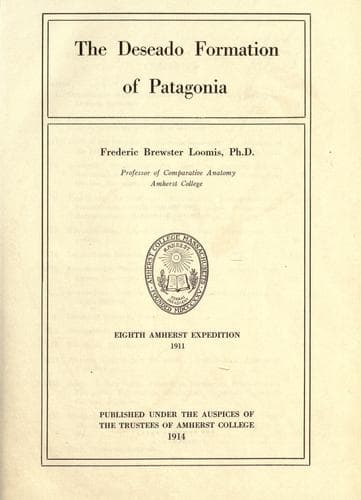
The Deseado Formation of PatagoniaLoomis, Frederic Brewster
Science
The Deseado Formation of Patagonia
Loomis, Frederic Brewster
Paleontology -- Patagonia (Argentina and Chile)
Colpodon Gaudry, in part, 1906, Anal. Palaeontologie, t. 1, p. 30.
The formula is
3 1 4 3
-------;
3 1 4 3
type species _L. gaudryi_. Of all the animals in the Deseado, this
is the most abundant. Using this species as a basis, the following
are the characteristic features. The first upper incisor is a small
cropping tooth, with a well-developed cingulum high up on the inner
face, which, when the tooth is worn down to the proper level, unites
with the main part of the crown and incloses for a short time a small
pit. On the external face there is also a feeble cingulum near the base
of the enamel. The second incisor is greatly enlarged into a caniniform
tush. In the species _L. oxyrhynca_, this tooth is much smaller but
as this reduction of the tushes is the only difference, I consider
these forms as the female. The third incisor is again small, and has a
well-developed cingulum on both the front and inner faces. The canine
is similar to inc. 3.
The first premolar is much reduced in size, with a weak cingulum on
the outer face, and probably another on the inner side (the tooth is
too much worn in my specimen to be sure). Beginning with premolar
2, the upper teeth are molariform. The premolars are rectangular in
outline, each being much wider than long, and each having a cingulum
on the outer side. On the inner side, along the anterior half of each
premolar, there is a high cingulum, which, though interrupted at
the anterior corner, continues around onto the anterior face of the
tooth. On a worn tooth this anterior cingulum unites with the grinding
surface, and leaves a small pit in the anterior internal corner, which
is very suggestive of _Rhynchippidae_. In the middle of the grinding
surface, there is an oblique pit, the remains of the basin in young
teeth. The molars continue to increase in size toward the rear. They
have a vestige of a cingulum on the external side, no cingulum on the
inner side, but on the anterior side for about one third the distance
there is a cingulum similar to that on the premolars. In the middle of
the grinding surface is an elongated oblique pit, similar to that in
the premolars, but a little more advanced, there being a trace of the
development of cristae.
In the lower dentition, the first two incisors are small cropping
teeth, with the anterior face flattened and having a trace of a
cingulum; while on the inner face the cingulum is well developed.
Incisor 3 is developed into a tush corresponding to inc. 2 in the upper
dentition. As in the upper teeth, there are two types, that of _L.
oxyrhynca_ with the tush only about twice the size of an incisor, and
that of _L. gaudryi_ with it much larger.
Public-domain text, read in full here on John Shaqi.
Reviews
Reviews
No reviews yet
Be the first to share your thoughts on this work.
Elsewhere in the archive
Join the Discussion
Join the discussion
Sign in to leave a comment or review.
Sign InorCreate an account