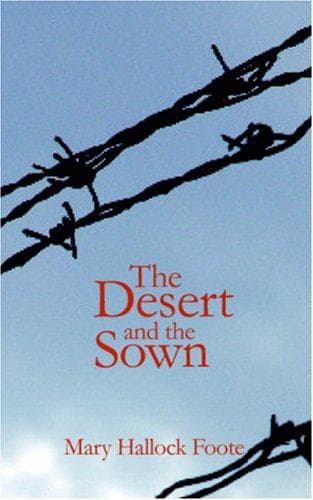
New York (State) -- Fiction; West (U.S.) -- Fiction
Paul spent some wakeful hours after that, trying not to think of Moya,
of his mother and Christine. They were of another world,--a world that
dies hard at twenty-four. Towards morning he slept, but not without
dreams.
He was in the pent-road at Stone Ridge. It was sunset and long shadows
striped the lane. A man stood, back towards him, leaning both arms on
the stone fence that bounds the lane to the eastward,--a plain farmer
figure, gazing down across the misty fields as he might have stood a
hundred times in that place at that hour. Paul could not see his face,
but something told him who it must be. His heart stood still, for he saw
his mother coming up the lane. She carried something in her hand covered
with a napkin, and she smiled, walking carefully as if carrying a treat
to a sick child. She passed the man at the fence, not appearing to have
seen him.
“Won't you speak to him, mother? Won't you speak to”--He could not utter
the name. She looked at him bewildered. “Speak? who shall I speak to?”
The man at the fence had turned and he watched her, or so Paul imagined.
He felt himself choking, faint, with the effort to speak that one word.
Too late! The moment passed. The man whom he knew was his father, the
solemn, quiet figure, moved away up the road unquestioned. He never
looked back. Paul grew dizzy with the lines of shadow; they stretched on
and on, they became the ties of a railroad--interminable. He awoke,
very faint and tired, with a lost feeling and the sense upon him of some
great catastrophe. The old man was sleeping deeply in his bunk, a ray
of white sunlight falling on his yellow features. He looked like one who
would never wake again. But as Paul gazed at him he smiled, and sighed
heavily. His lips formed a name; and all the blood in Paul's body dyed
his face crimson. The name was his mother's.
XII
THE BLOOD-WITE
A few hours seemed days, after the great disclosure. Both men had
recoiled from it and were feeling the strain of the new relation. Three
times since their first meeting the elder had adjusted himself quietly
to a change in the younger's manner to him. First there had been
respectful curiosity in the presence of a new type, combined with the
deference due a leader and an expert in strange fields. Then indignant
partisanship, pity, and the slight condescension of the nurse. This had
hurt the packer, but he took it as he accepted his physical downfall.
The last change was hardest to bear; for now the time was short, and, as
Paul himself had said, they were in the presence of the final unveiling.
So when Paul made artificial remarks to break the pauses, avoiding his
father's eye and giving him neither name nor title, the latter became
silent and lay staring at the logs and picking at his hands.
“If I was hunting up a father,” he said to himself aloud one day, “I'd
try to find a better lookin' one. I wouldn't pa'm off on myself no such
old warped stick as I be.” The remark seemed a tentative one.
Public-domain text, read in full here on John Shaqi.
Reviews
Reviews
No reviews yet
Be the first to share your thoughts on this work.
Join the Discussion
Join the discussion
Sign in to leave a comment or review.
Sign InorCreate an account