The Development of the Feeling for Nature in the Middle Ages and Modern Times — John Shaqi
The Development of the Feeling for Nature in the Middle Ages and Modern TimesBiese, Alfred
History
The Development of the Feeling for Nature in the Middle Ages and Modern Times
Biese, Alfred
Nature; Nature in literature
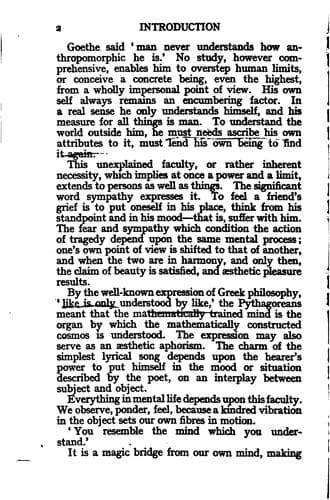
This unexplained faculty, or rather inherent necessity, which implies
at once a power and a limit, extends to persons as well as things.
The significant word sympathy expresses it. To feel a friend's grief
is to put oneself in his place, think from his standpoint and in his
mood--that is, suffer with him. The fear and sympathy which condition
the action of tragedy depend upon the same mental process; one's own
point of view is shifted to that of another, and when the two are in
harmony, and only then, the claim of beauty is satisfied, and
æsthetic pleasure results.
By the well-known expression of Greek philosophy, 'like is only
understood by like,' the Pythagoreans meant that the mathematically
trained mind is the organ by which the mathematically constructed
cosmos is understood. The expression may also serve as an æsthetic
aphorism. The charm of the simplest lyrical song depends upon the
hearer's power to put himself in the mood or situation described by
the poet, on an interplay between subject and object.
Everything in mental life depends upon this faculty. We observe,
ponder, feel, because a kindred vibration in the object sets our own
fibres in motion.
'You resemble the mind which you understand.'
It is a magic bridge from our own mind, making access possible to a
work of art, an electric current conveying the artist's ideas into
our souls.
We know how a drama or a song can thrill us when our feeling vibrates
with it; and that thrill, Faust tells us, is the best part of man.
If inventive work in whatever art or science gives the purest kind of
pleasure, Nature herself seeming to work through the artist, rousing
those impulses which come to him as revelations, there is pleasure
also in the passive reception of beauty, especially when we are not
content to remain passive, but trace out and rethink the artist's
thoughts, remaking his work.
'To invent for oneself is beautiful; but to recognise gladly and
treasure up the happy inventions of others is that less thine?' said
Goethe in his _Jahreszeiten_; and in the _Aphorisms_, confirming what
has just been said: 'We know of no world except in relation to man,
we desire no art but that which is the expression of this relation.'
And, further, 'Look into yourselves and you will find everything, and
rejoice if outside yourselves, as you may say, lies a Nature which
says yea and amen to all that you have found there.'
Certainly Nature only bestows on man in proportion to his own inner
wealth. As Rückert says, 'the charm of a landscape lies in this, that
it seems to reflect back that part of one's inner life, of mind,
mood, and feeling, which we have given it.' And Ebers, 'Lay down your
best of heart and mind before eternal Nature; she will repay you a
thousandfold, with full hands.'
Public-domain text, read in full here on John Shaqi.
Reviews
Reviews
No reviews yet
Be the first to share your thoughts on this work.
Join the Discussion
Join the discussion
Sign in to leave a comment or review.
Sign InorCreate an account