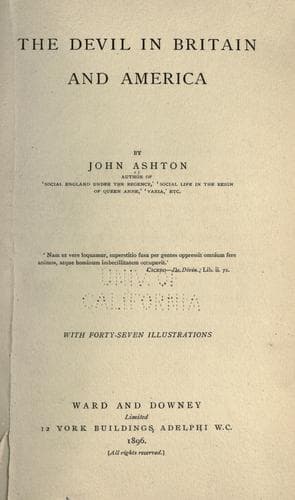
Devil; Witchcraft -- Great Britain; Witchcraft -- United States
‘The most remarkable occurrence in the Colony in the year 1655 was the
trial and condemnation of Mrs. Ann Hibbins for witchcraft. Her husband,
who died in the year 1654, was an agent for the Colony in England, several
years one of the assistants, and a merchant of note in the town of Boston;
but losses in the latter part of his life had reduced his estate and
increased the natural crabbedness of his wife’s temper, which made her
turbulent and quarrelsome, and brought her under church censures; and, at
length, rendered her so odious to her neighbours, as to cause some of them
to accuse her of witchcraft. The Jury brought her in guilty, but the
magistrates refused to accept the verdict, so the cause came to the
General Court, where the popular clamour prevailed against her, and the
miserable old woman was condemned and executed. Search was made upon her
body for tetts, and in her chests for puppets, images, etc., but there is
no record of anything of that sort being found. Mr. Beach, a minister in
Jamaica, in a letter to Doctor Increase Mather in the year 1684, says,
“You may remember what I have sometimes told you your famous Mr. Norton
once said at his own table, before Mr. Wilson the pastor, elder Penn and
myself and wife, etc., who had the honour to be his guests. That one of
your magistrate’s wives, as I remember, was hanged for a witch, only for
having more wit than her neighbours. It was his very expression, she
having, as he explained it, unhappily guessed that two of her persecutors,
whom she saw talking in the street, were talking of her; which, proving
true, cost her her life, notwithstanding all he could do to the contrary,
as he, himself, told us.”[127]
‘It fared with her as it did with Joan of Arc in France; some counted her
a saint, and some a witch, and some observed solemn marks of Providence
set upon those who were very forward to condemn her, and to brand others
upon the like ground, with the like reproach. This was the second instance
upon record of any persons being executed for witchcraft in New England.
She was not executed until June, 1656. She disposed of her estate by will
executed May 27, 1656, and a codicil June 16. She appointed several of the
principal gentlemen overseers, and hoped they would show her so much
respect, as to see her decently interred. There was no forfeiture of goods
for felony.’
Public-domain text, read in full here on John Shaqi.
Reviews
Reviews
No reviews yet
Be the first to share your thoughts on this work.
Elsewhere in the archive
Join the Discussion
Join the discussion
Sign in to leave a comment or review.
Sign InorCreate an account