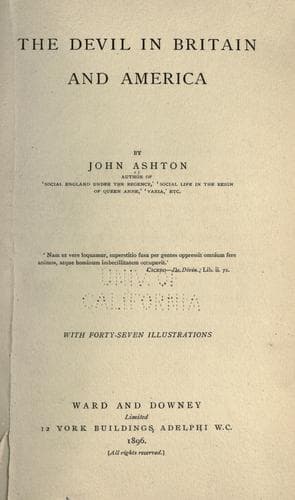
Devil; Witchcraft -- Great Britain; Witchcraft -- United States
There was a case of witchcraft in Hartford in 1662, when three women were
condemned, and one, at least, executed. In 1669 Susanna Martin, of
Salisbury, was tried on this charge, ‘but escaped at that time.’ Another
case at Groton in 1671, and yet another at Hampton in 1673. In 1658, in
Essex County, an attempt was made to convict one John Godfrey, of Andover,
as a witch, and at the County Court of Salem, June 29, 1659, he was bound
in one hundred pounds to appear when called upon. But he turned the tables
against his accusers, bringing actions against them for slander. In one
case he got twopence damages and twenty-nine shillings costs, in another
ten shillings damages and costs fifty shillings.
In November, 1669, Goody Burt, a widow, was prosecuted, but acquitted. In
1673 Eunice Cole, of Hampton, was tried, but her sentence was ‘to depart
from, and abide out of, this jurisdiction.’ On November 24, 1674, at
Salem, which even then was coming to the fore with its witches,
Christopher Browne was had up before the County Court, for ‘having
reported that he had been treating or discoursing with one whom he
apprehended to be the Devil, which came like a gentleman, in order to his
binding himself to be a servant to him. Upon his examination, his
discourse seeming inconsistent with truth, etc., the Court giving him good
counsel and caution, for the present dismiss him.’
On March 30, 1680, Caleb Powell was brought before the court at Ipswich,
under an indictment of witchcraft, in molesting one William Morse, of
Newbury, stones being thrown, furniture behaving abnormally, bedclothes
snatched off, and many other inconveniences; but it could not be proved,
and the wind-up of the affair was: ‘Though this court cannot find any
evident ground of proceeding against the said Caleb Powell, yet we
determine that he hath given such ground of suspicion of his so dealing,
that we cannot so acquit him, but that he justly deserves to bear his own
share, and the costs of the prosecution of the complaint.’ Elizabeth
Morse, wife of the above, was next, on May 20, 1680, tried and convicted
of witchcraft. On May 27 she was sentenced to death, was twice reprieved,
and ultimately allowed to return home.
CHAPTER XXIV.
Cotton and Increase Mather--The Case of Goodwin’s Daughter--That of
Mr. Philip Smith--The Story of the Salem Witchcrafts--List of
Victims--Release of Suspects--Reversal of Attainder, and Compensation.
Public-domain text, read in full here on John Shaqi.
Reviews
Reviews
No reviews yet
Be the first to share your thoughts on this work.
Elsewhere in the archive
Join the Discussion
Join the discussion
Sign in to leave a comment or review.
Sign InorCreate an account