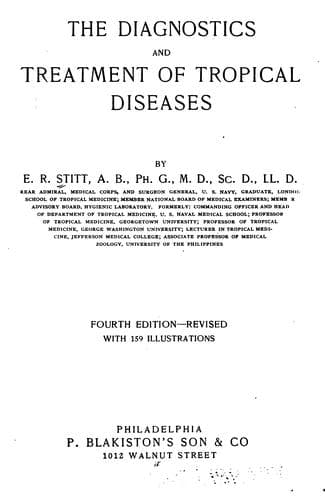
The diagnostics and treatment of tropical diseasesStitt, E. R. (Edward Rhodes)
Science
The diagnostics and treatment of tropical diseases
Stitt, E. R. (Edward Rhodes)
Tropical medicine
Knowles, at Shillong, has had long experience and striking success
with the intravenous administration of tartar emetic in kala-azar.
The heavy powder alone should be used—not the light powder. A 1%
solution is prepared in normal saline and the solution autoclaved
for 10 minutes at 110°C. If there is any opalescence or deposit
discard the solution. Knowles begins with the intravenous injection
of 3 to 4 cc. for an adult and gives the injections on alternate
days, increasing the dose until we are giving from 10 to 12 cc.,
the maximum dose. It will be noted that the dosage ranges from 3
to 10 centigrams (½ to 1½ grains). The amount of drug given for a
complete course of treatment is 200 cg. (33 grains). In the latter
part of the course of treatment the effects on the patient are more
marked so that caution must be observed, and it may be necessary
to lengthen the interval or reduce the dose. The injections
should not be given within two hours of a meal. Organic disease
of the heart or kidneys contraindicates the antimony treatment.
Coughing, a metallic taste in the mouth and constriction of the
chest are frequently noted following the injection. Nausea, colic
and diarrhoea show that the limit of the drug has been reached
and albuminuria and jaundice are signs of warning to decrease the
dose or stop the treatment. Christopherson considers that 5 to 8
grains will cure oriental sore, but for kala-azar 60 grains may be
necessary. This authority considers 3 grains of tartar emetic as
the maximum dose intravenously. For children under 1 year of age
the intravenous dose of the 1% solution is ¼ to 1 cc., from 1 to 5
years old 1 to 3 cc. and from 5 to 10 years of age 1 to 5 cc.
Manson-Bahr has reported the successful use of an
organic preparation of antimony, the sodium salt of
p-acetylaminophenylstibinic acid. It is a powder, readily soluble
in water and has the trade name of “stibenyl.” It can be injected
intravenously up to 0.8 gram. The drug contains 36% of antimony.
Knowles advises the use of tonics and, when indicated, of
anthelminthics. He also recommends cod liver oil to increase the
weight.
CUTANEOUS LEISHMANIASIS
Public-domain text, read in full here on John Shaqi.
Reviews
Reviews
No reviews yet
Be the first to share your thoughts on this work.
Elsewhere in the archive
Join the Discussion
Join the discussion
Sign in to leave a comment or review.
Sign InorCreate an account