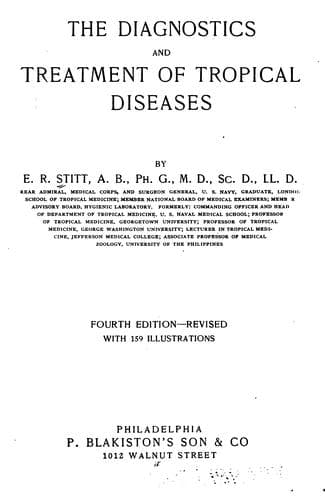
The diagnostics and treatment of tropical diseasesStitt, E. R. (Edward Rhodes)
Science
The diagnostics and treatment of tropical diseases
Stitt, E. R. (Edward Rhodes)
Tropical medicine
_Prophylaxis._—The best results in India have been obtained by
abandoning infected houses and establishing new ones for the
non-infected villagers, which need not be more than 300 yards from
the old ones, thus showing that mosquitoes and flies are probably
not concerned in transmission. Measures directed against the bedbug
seem to offer the best chance of success. Often, however, the bugs
are so deeply located in cracks of thick-walled houses that they may
not be reached by sulphur fumigation. Flaming of such crevices with a
plumber’s lamp has been recommended.
_Treatment._—Rogers has recommended quinine in doses of 60 to 70
grains daily, claiming thereby to have reduced the mortality of the
disease to 75%.
Castellani recommends a combination of quinine and atoxyl, while
Manson has reported success with atoxyl in 2 cases, giving 3 grains
intramuscularly every other day.
Salvarsan has been tried, but without much success, as is also true
of X-rays.
Some have tried cinnamate of soda with the idea of increasing the
leucocytes.
With the purpose of increasing leucocytes Rogers has tried
hypodermic injections of sodium nucleate and killed staphylococcus
vaccines as well as splenic substance tablets. The sodium nucleate
injections were most painful and did not increase the leucocytes.
He had some success with tabloids of spleen substance.
If the blood serum shows a lessened alkalinity the intravenous
injection of solutions of bicarbonate of soda should be tried.
Rogers reports very favorable results from the administration of
alkalies by mouth.
Recently hectine has been recommended in infantile kala-azar.
Following the successful employment of intravenous injections of
antimony tartrate in American leishmaniasis it has been used in
Indian and infantile kala-azar.
Rogers has used the same treatment in Indian kala-azar with a
considerable degree of success. He has also used a 5% ointment of
finely divided antimony. The treatment should be continued until
the temperature has been normal several weeks and the leucocyte
count approach the normal.
Antimony may now be considered as a specific in the treatment of the
leishmaniases.
Public-domain text, read in full here on John Shaqi.
Reviews
Reviews
No reviews yet
Be the first to share your thoughts on this work.
Elsewhere in the archive
Join the Discussion
Join the discussion
Sign in to leave a comment or review.
Sign InorCreate an account