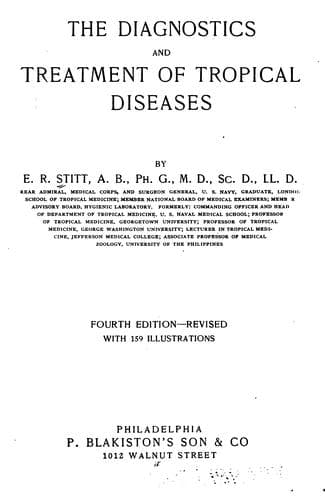
The diagnostics and treatment of tropical diseasesStitt, E. R. (Edward Rhodes)
Science
The diagnostics and treatment of tropical diseases
Stitt, E. R. (Edward Rhodes)
Tropical medicine
As a matter of fact there is a question as to the possibility
of the emetine treatment acting as a factor for the increase of
carriers.
Vedder considers that while emetine will kill the amoebae deeply
placed in the submucosa it has no effect on the more superficially
located cysts and suggests that it may be possible to treat
carriers by colonic irrigations with quinine or silver salts.
Emetine bismuth iodide has recently been highly recommended as our
best agent for eradication of _E. histolytica_ cysts of carriers.
=Treatment.=—The emetine treatment may now be considered as the
specific one for amoebic dysentery. In Brazilian ipecac about
72% of the total alkaloids is emetine, so that it is better than
Carthagena ipecac which contains only about 40% of emetine. Emetine
was recommended for dysentery as long ago as 1817, but owing to
the impossibility of differentiating between bacillary and amoebic
dysentery, until recently, this method of treatment was little
advocated.
In 1910 Vedder found that emetine was practically without power in
its action on dysentery bacilli but that it would kill amoebae,
even in dilutions of 1 to 100,000. He also found that deëmetized
ipecac was quite inert in its action on amoebae.
In 1912, Rogers, who had for years been an ardent advocate of
the ipecac treatment of amoebiasis, took up the treatment of
amoebic dysentery and its liver complications with emetine.
Reports from all over the world now attest the value of this drug
in the treatment of the acute manifestations of amoebiasis but
unfortunately note the inefficacy of this treatment on the encysted
forms of amoebae.
It is usual to give from ⅓ to ⅔ grain of emetine hydrochloride,
dissolved in sterile saline, by hypodermic injection into the
subcutaneous tissues. Some now give as high as 1 grain daily for
about ten days, but Vedder prefers ⅓ grain repeated 3 times daily. In
these doses there is practically no nausea.
It was found by Baermann and Heinemann that subcutaneous injections
of from 2 to 2½ grains daily caused indisposition and anorexia. The
subcutaneous injections are less painful than the intramuscular
ones.
Rogers has used emetine intravenously in doses of 1 grain without
bad effect.
Vedder calls attention to the fact that the minimal fatal dose
of emetine is several times less when administered to rabbits
intravenously than when given subcutaneously, so that after seeing
rabbits die with what was apparently centric paralysis immediately
after intravenous doses of comparatively small amounts of emetine
hydrochloride he would hesitate before administering 1 grain
intravenously in a human case.
Levy and Rowntree think emetine should not be given intravenously
except in extreme cases. Among ill effects of emetine they note
peripheral neuritis. Kilgore has reported such cases where even
wrist-drop was seen.
Public-domain text, read in full here on John Shaqi.
Reviews
Reviews
No reviews yet
Be the first to share your thoughts on this work.
Elsewhere in the archive
Join the Discussion
Join the discussion
Sign in to leave a comment or review.
Sign InorCreate an account