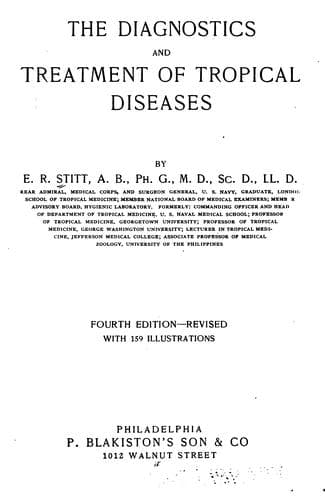
The diagnostics and treatment of tropical diseasesStitt, E. R. (Edward Rhodes)
Science
The diagnostics and treatment of tropical diseases
Stitt, E. R. (Edward Rhodes)
Tropical medicine
Low has treated cases successfully with keratin-coated tabloids of
emetine hydrochloride, giving ½ grain every night. Vedder has not
obtained satisfactory results with the drug by mouth.
Rogers considers that 15 grains of emetine is the fatal dose for
an adult man and as there is possibly a cumulative action it would
seem safer to continue the drug only for ten days and then later
repeat the course of hypodermics. Of course emetine cannot cure the
ulcerative lesions of amoebic colitis and as bacillary infections
are apt to set in when damaged tissues are present and, as such
infections do not yield to emetine, one must be prepared for failure
in treatment of symptoms in such cases.
Recognizing the great importance of immediate treatment to prevent
extension of the ulcerative process, as well as against abscess, the
rule was adopted in the medical care of the English forces, in the
Mediterranean, to give emetine so soon as a case of dysentery was
seen, not waiting for a determination of etiology. The treatment
ordered was 1 grain of emetine, hypodermically, every day for ten
days, or ½ grain morning and evening for ten days. There must not be
any intermission of a single day.
Before the introduction of emetine the usual treatment was with
ipecac.
It was customary to give 20 to 50 grains of powdered ipecac in
capsule, cachet or keratin-coated pills to a patient with an empty
stomach and who had had a dose of morphine or laudanum about 20
minutes before the time for giving the ipecac. The salol-coated
ipecac pills are generally used in America. The patient should be
in bed and should try to yield to the soporific influences of the
opiate. Any flow of saliva should be removed with gauze as its
swallowing would provoke nausea. Some use a mustard poultice to the
epigastrium. It is remarkable the change which this treatment will
effect in the number and character of the stools.
Many now think it advisable to give emetine hypodermically to reach
the amoebae deeply seated and, at the same time, to give ipecac by
mouth to destroy more superficially situated ones, or those in the
lumen of the gut. Alcresta ipecac has been recommended as a good
method of giving ipecac by mouth.
We do not have now the same confidence in emetine injections that
we formerly entertained. In Egypt the combination of emetine
injections with ½ grain keratin coated tablets of emetine by
mouth seemed to give better results in the more chronic stages of
amoebiasis.
Public-domain text, read in full here on John Shaqi.
Reviews
Reviews
No reviews yet
Be the first to share your thoughts on this work.
Elsewhere in the archive
Join the Discussion
Join the discussion
Sign in to leave a comment or review.
Sign InorCreate an account