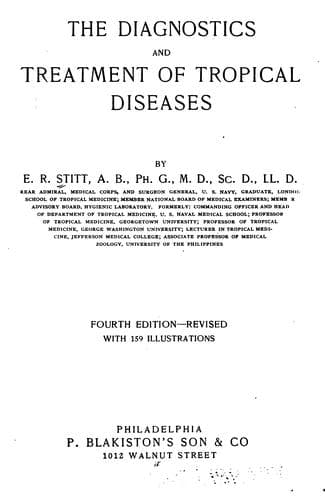
The diagnostics and treatment of tropical diseasesStitt, E. R. (Edward Rhodes)
Science
The diagnostics and treatment of tropical diseases
Stitt, E. R. (Edward Rhodes)
Tropical medicine
Upon taking in plague septicaemia blood the bacilli multiply
about the site of the proventriculus as well as distending the
oesophagus. This makes an obstruction to the entrance of the
stomach resulting in starvation of the flea. This naturally makes
the flea more voracious and in the ineffectual muscular efforts
to take in blood, regurgitation of the contents of the oesophagus
occurs, thereby infecting the person upon whom the flea is trying
to feed. This obstruction apparently may be overcome in some way as
the plague-infected flea does not necessarily die. Still from lack
of sufficient fluid such fleas are liable to be killed off if the
relative humidity is low, as in dry weather. Further investigations
have shown that the proventricular plug may be channeled, but in
such case valve action is lost and the contents of the stomach are
regurgitated, thus making such a flea more dangerous than one with
an obstructed proventriculus. Such fleas may continue infectious
for 67 days.
Very interesting in this connection is the fact that Heiser found
plague-infected fleas in the desk of a European at Manila who died
of plague. A mummified rat was found in one of the drawers of
this desk, from which successful animal inoculations for plague
were made. Heiser notes that data would indicate that these fleas
probably remained alive 2 weeks after the death of the rat which
brought about their infection. Another very striking finding during
the same Manila plague outbreak (1912-1913) was that bedbugs found
on the sleeping mat of a human victim of plague showed bipolarly
staining bacilli.
Bacot has carried on experiments in which fleas infected two months
previously and kept in a cool place could transmit plague. This
would indicate the danger from plague-infected fleas which had been
held in material packed away in boxes.
_Method of Spread._—The spread of plague epizootics among rats seems
to be rather by the fierce brown sewer rat, _Mus norvegicus_. The
more delicate black house rat, _Mus rattus_, usually receives its
infection from the sewer rat. When the rat dies the fleas leave the
dead body and seek a new host, preferably one similar to the one just
abandoned. The sewer rat reaching the basement of houses and dying
of plague is deserted by his fleas. These will attach themselves to
the house rats which go from basement to roof of the house and later
these dying are abandoned by the fleas which, in the absence of a
rodent host, will feed on man and infect him.
Public-domain text, read in full here on John Shaqi.
Reviews
Reviews
No reviews yet
Be the first to share your thoughts on this work.
Elsewhere in the archive
Join the Discussion
Join the discussion
Sign in to leave a comment or review.
Sign InorCreate an account