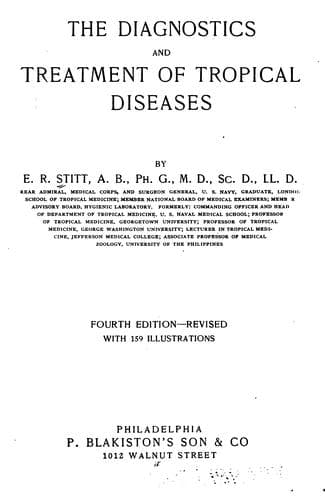
The diagnostics and treatment of tropical diseasesStitt, E. R. (Edward Rhodes)
Science
The diagnostics and treatment of tropical diseases
Stitt, E. R. (Edward Rhodes)
Tropical medicine
The house rat is rarely found in Europe while in many parts of the
tropics it is common and in close association with man. The fact
that the sewer rat avoids the upper portions of houses probably
explains the greater infrequency of plague epidemics in Europe
where this rodent is common. In former ages when the house rat was
prevalent in Europe we had great epidemics there. _Mus (Rattus)
norvegicus_ is of stout build with a blunt nose and small opaque
ears which barely reach the eyes when laid forward. The tail is
shorter than the length of the head and body together (89% of such
length). With _Mus rattus_ we have a delicately built rat with a
slender head and sharp nose. The ears are translucent and large
and reach beyond the middle of the eye when extended. The rather
delicate tail is about 25% longer than the length of the head and
body taken together.
Recently it has been found that a guinea pig set free in a house
suspected of having plague fleas becomes infected if such fleas are
present. The fleas would probably prefer the guinea pig to man and
such a measure would in some degree be protective to man. It is
however for the detection of plague infection that the measure is
employed and the guinea pig is termed the “Plague barometer.” In
Madras there is practically an absence of _Mus norvegicus_ although
_Mus rattus_ is present in numbers and the comparative freedom of
the city from plague is striking.
The principal rat flea of the Orient is _Xenopsylla cheopis_. This
flea is without combs like _Pulex irritans_, the human flea, but
is of a lighter color and has an ocular bristle near the upper
margin of eye and two bristles posterior to the antennae. In Europe
and the United States _Ceratophyllus fasciatus_ is the common rat
flea. Many other species of fleas transmit plague and it is also
possible that the bedbug may play a part in spreading infections
from man to man. Vergbitski has transmitted plague from man to the
rat by infected bedbugs. In Siberia, a marmot, the tarabagan, is
supposed to play the part of the rat in plague transmission. In
California, the ground squirrel, _Citellus beecheyi_, has become
infected and may transmit the disease by its flea, _Ceratophyllus
acutus_. In the Tropics plague tends to prevail only at times when
the temperature is between 10° and 30°C. It is the effect on the
flea of cold weather which causes the disappearance of bubonic
plague at such times. The bacillus of plague can withstand freezing
temperatures. Sunlight and drying are the especially inimical
factors for _B. pestis_. Dry seasons are inimical to the spread of
plague and it is especially in very rainy seasons that epidemics
rage.
Public-domain text, read in full here on John Shaqi.
Reviews
Reviews
No reviews yet
Be the first to share your thoughts on this work.
Elsewhere in the archive
Join the Discussion
Join the discussion
Sign in to leave a comment or review.
Sign InorCreate an account