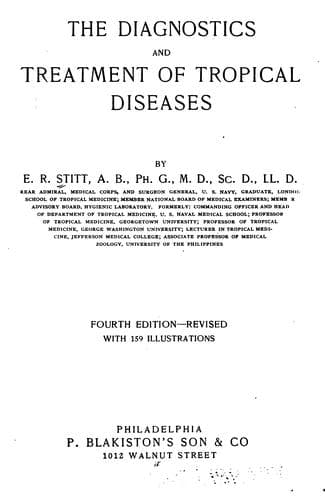
The diagnostics and treatment of tropical diseasesStitt, E. R. (Edward Rhodes)
Science
The diagnostics and treatment of tropical diseases
Stitt, E. R. (Edward Rhodes)
Tropical medicine
This was about the first definitely proven connection between water
and cholera. In 1854 it was noted that cholera was about 10 times
as prevalent in Golden Square as in other adjacent parts of London.
Various factors, such as previous droughts, stagnation of lower
strata of the atmosphere, sewerage defects and subsoil drainage
were found to be the same in Golden Square as elsewhere. It was
noted that the number of cases increased in the neighborhood of
the Broad Street well. The employees of a cartridge factory where
this well water was used gave a large number of cases while an
adjoining brewery, which had a well of its own and served out beer
to its employees, did not furnish a single case. Very striking was
the case of a lady living at Hampstead, a section of London which
was then free from cholera, who had acquired a liking for the
water of this well and had brought out to her regularly bottles of
water from the well. This lady drank some of the water on August
31 and was seized with cholera the next day. A niece drank of the
same water and died of cholera as well as the aunt. A servant also
contracted the disease but recovered.
Macnamara has noted the circumstance of a vessel of water, which
became contaminated with cholera stools, but which at the time it
was drunk by 19 persons did not show anything suspicious in odor,
color or taste. One person was stricken one day afterward, two on the
third day and two others came down with cholera on the fourth day. It
will be noted that only 5 of the 19 were attacked. A similar lack of
susceptibility of a certain proportion of people, equally exposed,
has been noted in all cholera outbreaks. It is probable that of those
of the 19 who did not contract cholera there were developed a certain
number of cholera carriers.
_Food Transmission._—Food contaminated by dejecta from cholera
patients or carriers is dangerous in proportion to its condition of
moisture. Drying and the development of inimical organisms are the
two chief factors in destroying the cholera vibrio. Temperature and
sunshine are operative in assisting the drying process.
Lettuce and celery are particularly dangerous because of the
favorable condition of moisture in their folds and imbrications.
Furthermore these vegetables are eaten uncooked and may have been
fertilized with night soil (human excrement) which material, if
containing cholera dejecta, would infect the plants. Milk is a
splendid culture medium for cholera vibrios but, upon becoming
acid, sterilizes itself of these vibrios. In sterilized milk,
however, they live for extended periods, as long as sixty days
and, even when such milk is contaminated by faecal material
containing other organisms besides the cholera vibrio, the vibrios
live much longer than they do in raw milk.
Public-domain text, read in full here on John Shaqi.
Reviews
Reviews
No reviews yet
Be the first to share your thoughts on this work.
Elsewhere in the archive
Join the Discussion
Join the discussion
Sign in to leave a comment or review.
Sign InorCreate an account