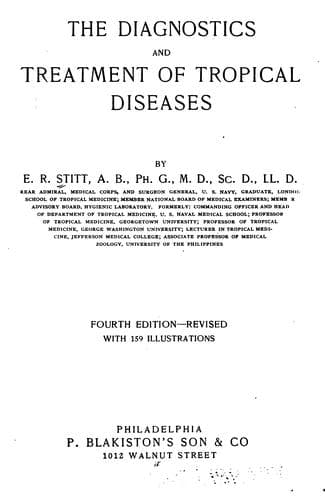
The diagnostics and treatment of tropical diseasesStitt, E. R. (Edward Rhodes)
Science
The diagnostics and treatment of tropical diseases
Stitt, E. R. (Edward Rhodes)
Tropical medicine
Milk is liable to be contaminated by flies which have been in
contact with cholera stools. Water that has been boiled and food
that has been cooked should subsequently be scrupulously protected
from flies or other contaminating agents. Uncooked shell fish are
peculiarly dangerous in cholera outbreaks.
In India, sun-dried fish, which are frequently covered with flies
during the curing process, are a factor in the spread of cholera.
_Transmission by Carriers._—This is now universally recognized as
the most important factor in the spread of cholera. Dunbar was the
first to draw attention to the presence of virulent cholera spirilla
in the faeces of apparently healthy persons during the Hamburg
epidemic of 1892.
Since that time these observations have been generally confirmed.
In some instances as many as 20% of those who have been in
immediate contact with a cholera patient have become carriers,
some showing symptoms of cholera but a larger proportion excreting
cholera spirilla while continuing in health.
While cholera prevailed in Manila, McLaughlin found from 6 to 7% of
carriers among healthy persons living in the infected districts.
Pottevin has recently reported that of 13,000 pilgrims examined 1.7
per thousand carried cholera vibrios. The carriers were especially
common among the dysenteric patients. During the Naples epidemic
of 1911 it was found that on the average 10% of healthy people in
contact with cholera cases became carriers. It was estimated that
90% of the cases in this epidemic were infected by sick or healthy
carriers.
Sergeant has recently reported the case of a healthy carrier who
continued to excrete cholera vibrios for two months and during this
time was in contact with 8 persons, 7 of whom became infected and 4
died. In Manila it was found that many of the children reported as
dying of meningitis or infantile beriberi were cholera cases.
The vibrios are rarely excreted in the faeces of the cholera patients
longer than seven to ten days. Frequently they disappear in three or
four days.
With healthy cholera carriers the period of the continuance of
vibrio excretion is equally short but cases have been reported
where periods of from three weeks to two months have been noted. It
is usually stated that 97% of carriers become vibrio free within a
month.
Public-domain text, read in full here on John Shaqi.
Reviews
Reviews
No reviews yet
Be the first to share your thoughts on this work.
Elsewhere in the archive
Join the Discussion
Join the discussion
Sign in to leave a comment or review.
Sign InorCreate an account