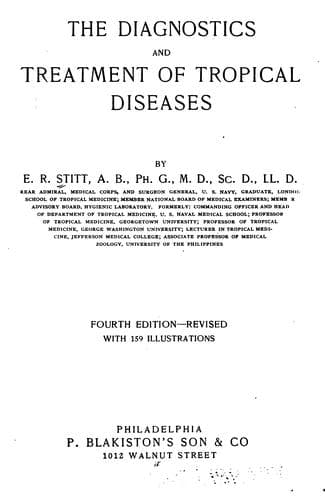
The diagnostics and treatment of tropical diseasesStitt, E. R. (Edward Rhodes)
Science
The diagnostics and treatment of tropical diseases
Stitt, E. R. (Edward Rhodes)
Tropical medicine
Sellards had success in combating anuria, which is one of the most
dangerous conditions encountered in cholera, and at the same time
answered equally well with normal saline in relieving collapse, by
giving 2% sodium bicarbonate injections.
There is a marked acidosis in cholera and this form of treatment
seems indicated.
The objection to using sodium carbonate is that the salt has
a lytic action on red cells in vitro and furthermore Sellards
found that it tended to cause convulsions in one of his cholera
cases. Sodium bicarbonate, even in 4 or 5% concentration, does
not have any haemolysing effect on the red cells. Of course it is
true that in sterilization the bicarbonate tends to be converted
into carbonate but Sellards found that by sterilization in an
autoclave connected with live steam, at 7 pounds pressure, this was
minimized, only about 25% of the bicarbonate being converted into
carbonate after 1 hour.
If the temperature by rectum is about normal or slightly below, the
temperature of the fluid should be 102° to 104°F. and one usually
gives about 2 quarts.
Owing to the collapse of the veins it is usually necessary to cut
down on them instead of inserting the needle through the skin as for
salvarsan injections. The same apparatus as for salvarsan injections
is suitable but with a somewhat larger container as we give from 1 to
2 quarts of fluid. At least fifteen minutes should be taken up for
the introduction of 1 quart of fluid.
To determine the necessity for intravenous infusion in cholera
Rogers has recently recommended the employment of small bottles
containing aqueous solution of glycerine with specific gravities
varying from 1048 to 1070, increasing the specific gravity in each
successive bottle by 2°.
Drops of blood from the cholera patient are deposited at the
center of the surface of the fluid in the bottles from a capillary
pipette. If the specific gravity of the blood is 1062 at least a
liter of saline or sodium bicarbonate solution is needed. If 1066,
at least 2 liters. Formerly he estimated the indications by blood
pressure, considering a pressure of 80 in Europeans or of 70 in
natives as indicating intravenous injections.
On the whole the reports from the use of anti-cholera sera are
not very encouraging. Savas, however, was favorably impressed by
such treatment during the Balkan war. It should be administered
intravenously and early in the attack and given in doses of 50 cc. Of
61 severe cases, so treated, the mortality was 55.7%. Of 17 severe
cases, not receiving serum treatment, all died.
Hot water bottles should be used to keep up the body heat. No food
should be given during the first thirty-six hours but after that
time we may give broths or albumin water.
CHAPTER XVI
MALTA FEVER
DEFINITION AND SYNONYMS
Public-domain text, read in full here on John Shaqi.
Reviews
Reviews
No reviews yet
Be the first to share your thoughts on this work.
Elsewhere in the archive
Join the Discussion
Join the discussion
Sign in to leave a comment or review.
Sign InorCreate an account