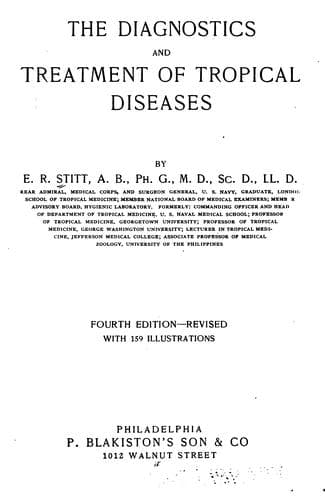
The diagnostics and treatment of tropical diseasesStitt, E. R. (Edward Rhodes)
Science
The diagnostics and treatment of tropical diseases
Stitt, E. R. (Edward Rhodes)
Tropical medicine
or white rice contains as a rule less than 0.4% of phosphorus
pentoxide while the beriberi-preventing rices contain more than
0.4% of this compound for which reason legislation has required
rice to have more than 0.4% phosphorus pentoxide.
Siam rice is a polished white rice which contains about 0.25%
phosphorus pentoxide and has more often been associated with severe
outbreaks of beriberi than Rangoon rice, which has about 0.32%,
this latter, however, being a well-recognized beriberi-producing
rice. Unpolished rice contains about 0.55% of phosphorus pentoxide.
Natives generally prefer the polished rice because it is clean and
free from weevils, while the undermilled kind is dirty. Parboiled
rice has a disagreeable odor.
Voegtlin has recommended a P_{2}O_{5} requirement of 0.5% for corn
products and 1% for wheat ones. Thus whole wheat contained 1.12%
while highly milled flour had only 0.114%. Fowls fed on this flour
developed polyneuritis in twenty to thirty-two days.
Whole corn contains 0.76% P_{2}O_{5}, while highly milled corn
grits has approximately 0.2%, and highly milled corn meal about
0.3%. These highly milled corn products produced polyneuritis
within from thirty to thirty-five days.
With rock ground corn meal, containing 0.7% P_{2}O_{5} the fowls
remained well.
_Experiment of Fraser and Stanton._—While there have been numerous
instances reported to show the connection between polished rice and
beriberi, when such rice was the predominating article of diet, it
will suffice to refer to the experiments of Fraser and Stanton and of
Strong.
In 1909, Fraser and Stanton experimented with 493 Javanese coolies
who were employed in building a road far removed from any village
which might introduce the factor of bacterial etiology into the
problem. They noted that the Javanese prefer white rice, and
reference is made to the fact that many cases of beriberi occurred
among these laborers in 1906, which outbreak ceased upon requiring
them to eat parboiled rice at the suggestion of Doctor Braddon.
They state that they informed the coolies of the danger of white
rice but, notwithstanding, they all expressed a preference for the
white rice over parboiled rice. For the purpose of comparison, only
one-half were allowed the white rice diet. The two parties were
quartered in virgin jungle and were isolated from each other by an
interval of 7 miles. Of 220 individuals on white rice there were 20
cases of beriberi recorded while among 273, who lived on parboiled
rice, no cases occurred.
Public-domain text, read in full here on John Shaqi.
Reviews
Reviews
No reviews yet
Be the first to share your thoughts on this work.
Elsewhere in the archive
Join the Discussion
Join the discussion
Sign in to leave a comment or review.
Sign InorCreate an account