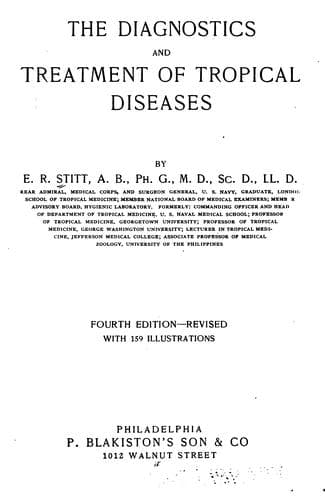
The diagnostics and treatment of tropical diseasesStitt, E. R. (Edward Rhodes)
Science
The diagnostics and treatment of tropical diseases
Stitt, E. R. (Edward Rhodes)
Tropical medicine
It is well to remember that beriberi is but a form of multiple
neuritis which in many cases shows only motor and sensory
disturbances of the lower portions of the upper and lower extremities.
In fact an extensive epidemic of arsenical neuritis, or, to be more
exact, a neuritis in which both alcoholic and arsenical factors
were operative, was regarded by eminent authorities as beriberi.
The key to beriberi, however, is the peculiar and striking selection
of the vagus nerve in the degenerative processes as well as those of
the peripheral nerves of the extremities. It is vagal involvement,
giving disturbances of heart particularly and lungs in less degree,
which chiefly differentiates beriberi from other forms of multiple
neuritis.
Another peculiarity of beriberi is the tendency to vasomotor
involvement as shown in the patchy areas of oedema.
_Epidemic Dropsy._—Beriberi is typically a nonfebrile disease.
There is, however, a disease with fever, called epidemic dropsy,
which seems to have a similar etiology to beriberi. It also shows
the symptoms of a peripheral neuritis plus cardiac disturbances. In
fact Pearse has maintained the identity of the two diseases. Greig
considers epidemic dropsy as resembling ship beriberi.
The first record of epidemic dropsy was during a famine in Southern
India in 1877. Outbreaks again occurred in 1902 and 1907. The fact
that it is a disease which often shows a house infection has caused
the advancing of a theory that the bedbug transmits the disease.
While greatly resembling beriberi clinically the following points
of difference are usually noted by those who hold that it is a
distinct disease entity.
1. The presence of fever, which rarely exceeds 102°F. and is
usually only about 99° to 100°F.
2. An erythematous rash upon the oedematous portions of the
extremities.
3. The frequent generalized oedema, which suggested the designation
dropsy for the disease, cannot be differentiated from wet beriberi.
4. The neuritis manifestations are slight or absent. There may
be formication of the feet but anaesthesia is wanting. The vagal
involvement gives cardiac disturbances. There is anaemia.
_Infantile Beriberi._—There is also a condition in nursing infants
which would be difficult to recognize if unaware of the existence of
this type of beriberi. It is called _infantile beriberi_.
Public-domain text, read in full here on John Shaqi.
Reviews
Reviews
No reviews yet
Be the first to share your thoughts on this work.
Elsewhere in the archive
Join the Discussion
Join the discussion
Sign in to leave a comment or review.
Sign InorCreate an account