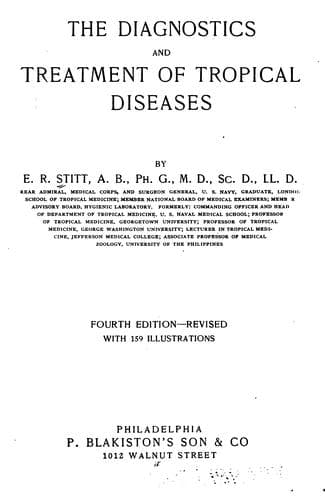
The diagnostics and treatment of tropical diseasesStitt, E. R. (Edward Rhodes)
Science
The diagnostics and treatment of tropical diseases
Stitt, E. R. (Edward Rhodes)
Tropical medicine
In 1898 Hirota first noted the existence of a condition in infants
nourished by beriberi mothers which has more recently been
carefully studied by McLaughlin and Andrews and to which the name
infantile beriberi is now generally given. In the Philippines it is
called “taon.” Clinically there is restlessness, vomiting, altered
voice, increased heart action, oedema and cyanosis. After death
there is found a marked hypertrophy and dilatation of the right
side of the heart with no change of the left side. The peripheral
nerves also show the lesions of beriberi of adults but of less
intensity.
The disease most often shows itself in an acute form, the child
rather suddenly being seized with great pain, crying constantly and
soon becoming cyanosed. Death, which may occur in a few minutes or
hours, is often thought to be due to meningitis, although there is
no fever or true convulsions. There is only rigidity of the body.
Less frequently the disease appears in a chronic form in which
vomiting and constipation are most marked. There is often a history
of the loss by the mother, who herself may have only a rudimentary
beriberi, of several children from this disease.
The infants improve rapidly when other infant feeding is
substituted for the mother’s milk. An extract of rice polishings
gives striking results in these cases.
_Asylum Beriberi._—The beriberi outbreaks which have frequently
been reported from European and American camps, prisons and
asylums do not differ from the cases one may see in the
classical distribution of the disease among the rice-eating
populations of the Orient. The cause is the same, a deficiency
in beriberi-preventing vitamines, and the symptoms are similar.
These vitamines may be deficient in the rice or other cereal or
proteid food supplied. Again they may have originally been present
in sufficient quantity but later destroyed by too great heat or
otherwise.
=Types of Beriberi.=—The ordinary clinical division of beriberi
is into (1) _wet or dropsical beriberi_ and (2) _dry or atrophic
beriberi_. At the same time, in a typical case, we find such
a combination of the vasomotor disturbances which lead to the
oedematous or dropsical manifestations of wet beriberi, and likewise
of those of peripheral nerve involvement causing more or less
development of muscular palsies or atrophies, as seen more strikingly
in dry or atrophic beriberi, that it does not seem advisable to
employ such a division.
In fact typical cases of wet or dropsical beriberi after a profuse
diuresis may change in a short time, as Manson has so aptly stated,
from a bloated carcass to little more than skin and bones and
assume all the appearance of a case of dry or atrophic beriberi.
Public-domain text, read in full here on John Shaqi.
Reviews
Reviews
No reviews yet
Be the first to share your thoughts on this work.
Elsewhere in the archive
Join the Discussion
Join the discussion
Sign in to leave a comment or review.
Sign InorCreate an account