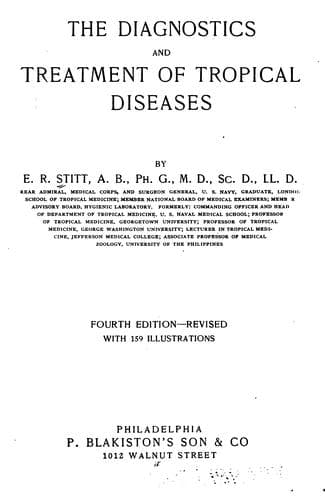
The diagnostics and treatment of tropical diseases — John Shaqi
The diagnostics and treatment of tropical diseasesStitt, E. R. (Edward Rhodes)
Science
The diagnostics and treatment of tropical diseases
Stitt, E. R. (Edward Rhodes)
Tropical medicine
In the view of our present knowledge it is remarkable that Lancisi,
in 1718, should have associated marshes with the development of
gnats, which insects he thought could not only introduce with
their proboscides the putrefying organic matter of such swamps but
animalcules as well.
In 1638 Countess del Chinchon, the wife of the Viceroy of Peru, was
cured of an intermittent fever by the employment of the bark of
certain trees which bark was introduced into Europe in 1640. The
origin of the name cinchona is thus explained.
While Morton and Sydenham in 1666 noted the specific action of
cinchona in certain fevers it remained for Torti, in 1753, by the
use of cinchona, clinically to differentiate those fevers which
were cured by cinchona from those which failed to yield to this
specific. Quinine was not introduced until after 1820. Audouard, in
1803, was the first to draw attention to the splenic enlargement of
malaria.
The views of Nott and Beauperthuis as to transmission of malaria
and yellow fever by insects are considered under the latter disease.
In 1847 Meckel announced that the dark color of malarial organs
was due to a pigment and in 1848 Virchow noted that this pigment
was contained in cells. In 1875, Kelsch observed pigmented bodies
in malarial blood and in 1880 came to the conclusion that these
pigmented cells were diagnostic of malaria.
The year 1880 is the most important one in the history of malaria
for on November 6, 1880, Laveran, at Constantine, first saw the
parasites of malaria while carrying on investigations as to the
origin of the pigmented bodies and melaniferous leucocytes. He not
only noted the findings of spherical pigmented bodies but also of
crescents and in particular the flagellation of the male gamete
which demonstrated to him that these were living bodies.
The name _Oscillaria malariae_ was proposed on account of the
movements of the flagellate body, but had to be dropped as not
valid, the generic name _Oscillaria_ having been previously applied.
When these bodies were demonstrated to various Italian authorities,
in 1882, they were thought by them to be degenerated red cells.
It may be stated that at this time the Italians, influenced by
the work of Pasteur, were convinced that an organism, _Bacillus
malariae_, reported by Klebs and Crudeli (1879) to have been
isolated from water and soil of malarious districts, was the cause
of malaria. This bacillus was said to be cultivable on ordinary
media and to be capable, when injected into man, of producing
malaria.
Public-domain text, read in full here on John Shaqi.
Reviews
Reviews
No reviews yet
Be the first to share your thoughts on this work.
Join the Discussion
Join the discussion
Sign in to leave a comment or review.
Sign InorCreate an account