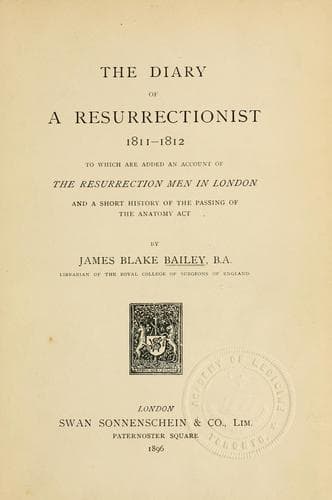
The Diary of a Resurrectionist, 1811-1812: To Which Are Added an Account of the Resurrection Men in London and a Short History of the Passing of the Anatomy ActBailey, James Blake
History
The Diary of a Resurrectionist, 1811-1812: To Which Are Added an Account of the Resurrection Men in London and a Short History of the Passing of the Anatomy Act
Bailey, James Blake
Body snatching
Bodies of suicides, and of those who had met with an accidental death,
were frequently stolen whilst they were awaiting the coroner's inquest.
Often in these cases the body-thieves, after selling the subject to a
teacher of anatomy, secretly gave information to the police where the
missing body might be found. It was then seized by the police, and, after
the inquest, handed over to those who claimed to be relatives; these
supposed relatives were frequently confederates of the thieves, and by
them the body was at once taken off and again sold to another teacher.
* * * * *
The following case is from a newspaper of 1823:
"SUICIDE AND THE BODY STOLEN.--Tuesday evening last a young woman of
respectable and interesting appearance was observed for some time parading
the banks of the Surrey Canal, Camberwell, in a melancholy mood, and at
length she plunged into the water; on which a man rushed in after her and
dived several times, but failed in recovering the body, which was not
found till the following morning, when it was taken to the Albany Arms,
near the Canal, for the Coroner's inquest, which was to have taken place
on Thursday. On the landlord proceeding to the shed on Wednesday morning,
where the body had been deposited, he discovered, that in the course of
the night, it had been broken open, and the corpse of the female stolen
away. He instantly repaired to the Police Office, Union Street, and gave
information of the circumstance to the Magistrates, who gave orders that
immediate inquiry should be made at Mr. Brookes's, where the body has
since been discovered and given up. The poor woman was unclaimed, and the
verdict of the Coroner's Jury was 'Found Drowned.'"
A favourite trick, in the carrying out of which a woman was generally
necessary, was that of claiming the bodies of friendless persons who died
in workhouses, or similar institutions. Immediately it was found out that
such an one was dead a man and woman, decently clad in mourning, in great
grief, and often in tears, called at the workhouse to take away the body
of their dear departed relative. If the trick proved successful, as it
often did, the body was taken straight off to one of the schools and sold.
The parish authorities, probably, were not over particular about giving up
the body, if the deceased were a stranger, as by this means they saved the
cost of burial.
Subjects, too, were obtained from cheap undertakers, who kept the bodies
of the poor until the time for burial. The coffin was weighted so as to
conceal the fraud, and the mockery of reading the Burial Service over it
was gone through in the presence of the unsuspecting relatives.
That some bodies were obtained by murder there can be no doubt. The
exposure caused by the trials of Burke and Hare in Edinburgh, and Bishop
and Williams in London, proves this.
Public-domain text, read in full here on John Shaqi.
Reviews
Reviews
No reviews yet
Be the first to share your thoughts on this work.
Join the Discussion
Join the discussion
Sign in to leave a comment or review.
Sign InorCreate an account