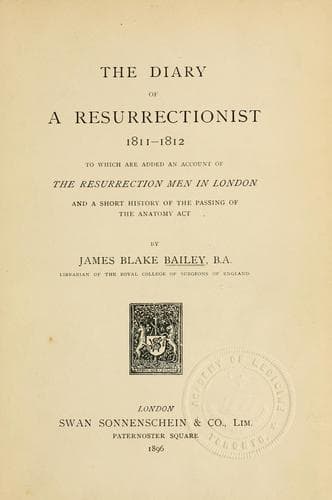
The Diary of a Resurrectionist, 1811-1812: To Which Are Added an Account of the Resurrection Men in London and a Short History of the Passing of the Anatomy Act — John Shaqi
The Diary of a Resurrectionist, 1811-1812: To Which Are Added an Account of the Resurrection Men in London and a Short History of the Passing of the Anatomy ActBailey, James Blake
History
The Diary of a Resurrectionist, 1811-1812: To Which Are Added an Account of the Resurrection Men in London and a Short History of the Passing of the Anatomy Act
Bailey, James Blake
Body snatching
Besides watching, many other devices were tried to prevent the
depredations of the resurrection-men; spring guns were set in many of the
cemeteries, but these were often rendered harmless. If the men intended
going to a certain grave at night, late in the afternoon a woman, in deep
mourning, would walk round the part of the cemetery in which the grave was
situated, and contrive to detach the wires from the guns. Loose stones
were placed on the walls of the grave-yard, so as to make scaling the
walls almost an impossibility; this was useless when the custodian had a
house with a window looking into the burial-place. If entrance could not
be obtained in this way, there was generally some other house through
which the men could gain admission to the grave-yard. Mort-safes, or
strong iron guards, were placed over newly-made graves for protection;
some of these can be seen at the present day in the Greyfriars Churchyard,
Edinburgh (see illustrations).
[Illustration: MORTSAFE IN GREYFRIARS CHURCHYARD, EDINBURGH.]
Iron coffins were also used by some persons to protect their friends from
the Resurrectionist. The following interesting advertisement appeared in
_Wooler's British Gazette_ for October 13th, 1822:
"Many hundred dead bodies will be dragged from their wooden coffins this
winter, for the anatomical lectures (which have just commenced), the
articulators, and for those who deal in the dead for the supply of the
country practitioner and the Scotch schools. The question of the right to
inter in iron is now decided. Lord Chief Justice Abbott declared he wished
they might be generally used; Justice Bailey declared that if the
Ecclesiastical Court was to grant a suit for a fee, they, the Court of
King's Bench, would grant a prohibition, knowing it had no such right. Sir
William Scott, now Lord Stowell, decided and directed the interment
without any extra fee, as this question was raised by an undertaker; those
undertakers who have IRON COFFINS must divide the profits of the funeral
with EDWARD LILLIE BRIDGMAN. TEN GUINEAS reward will be paid on the
conviction of any Parish Officer demanding an extra fee, whereby I shall
lose the sale of a coffin. The violation of the sanctity of the grave is
said to be needful, for the instruction of the medical pupil, but let each
one about to inter a mother, husband, child, or friend, say shall I devote
this object of my affection to such a purpose; if not, the only safe
coffin is Bridgman's PATENT WROUGHT-IRON ONE, charged the same price as a
wooden one, and is a superior substitute for lead. Edward Lillie Bridgman,
34, Fish Street Hill, and Goswell Street Road, performs funerals in any
part of the kingdom, and by attention to moderate charges insures the
recommendation of those who employ him. Twenty-five private grounds within
the Bills of Mortality receive them; dues from seven shillings to one
guinea. Patent cast-iron tombs and tablets, superior to stone."
Public-domain text, read in full here on John Shaqi.
Reviews
Reviews
No reviews yet
Be the first to share your thoughts on this work.
Join the Discussion
Join the discussion
Sign in to leave a comment or review.
Sign InorCreate an account