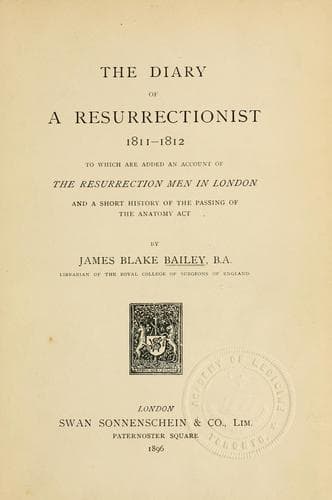
The Diary of a Resurrectionist, 1811-1812: To Which Are Added an Account of the Resurrection Men in London and a Short History of the Passing of the Anatomy Act — John Shaqi
The Diary of a Resurrectionist, 1811-1812: To Which Are Added an Account of the Resurrection Men in London and a Short History of the Passing of the Anatomy ActBailey, James Blake
History
The Diary of a Resurrectionist, 1811-1812: To Which Are Added an Account of the Resurrection Men in London and a Short History of the Passing of the Anatomy Act
Bailey, James Blake
Body snatching
In some burial-grounds, houses were built in which the bodies could be
kept until they were putrid, and therefore useless to the
resurrection-men. Such a house is still standing in the burial-ground at
Crail.[17]
[Illustration: HOUSE AT CRAIL (Described on page 80). Over the door is
the following inscription: "Erected for securing the Dead. Ann. Dom.
MDCCCXXVI."]
[Illustration: HOUSE AT CRAIL (Described on page 80). Over the door is
the following inscription: "Erected for securing the Dead. Ann. Dom.
MDCCCXXVI."]
As a rule, the resurrection-men were able not only to supply the
London schools from the grave-yards in and around the Metropolis, but also
to send bodies to some of the provincial schools; the Diary shows that
even Edinburgh received some of the proceeds of the work of this London
gang. If, however, from increased vigilance or other causes, the supply of
bodies ran short in London, recourse was had to the provinces. A case
occurred some seventy years ago at Yarmouth. A man died, and was buried in
St. Nicholas Churchyard. Not long after, his wife died also. On the
husband's grave being opened, it was discovered that the man's body had
been removed; this led to a panic amongst people in Yarmouth who had
recently buried friends in that churchyard. Many graves were opened, and,
in a large number of instances, were found to have been violated. This led
to a regular watch being established over newly-made graves in the
churchyard. It was the custom of the resurrection-men, when they had
bodies to send from the country to London, to forward them so that they
should, in outward appearance, correspond with the class of goods exported
from the place where the bodies had been obtained. If the goods usually
came to London in crates, crates were used by the body-snatchers; if
ordinary packing-cases, then the bodies were enclosed in like receptacles.
The proceeds of the exhumations at Yarmouth were probably packed in
barrels, and came through Billingsgate.
In 1826 three casks, labelled "Bitter Salts," were taken down to George's
Dock at Liverpool, to be shipped on board the _Latona_, bound for Leith; a
full description of this transaction was printed as a broadside, of which
the following is a copy:
"RESURRECTIONISTS AT LIVERPOOL.
"Discovery of 33 Human Bodies, in Casks, about to be shipped from
Liverpool for Edinburgh, on Monday last, October 9, 1826.
Public-domain text, read in full here on John Shaqi.
Reviews
Reviews
No reviews yet
Be the first to share your thoughts on this work.
Join the Discussion
Join the discussion
Sign in to leave a comment or review.
Sign InorCreate an account