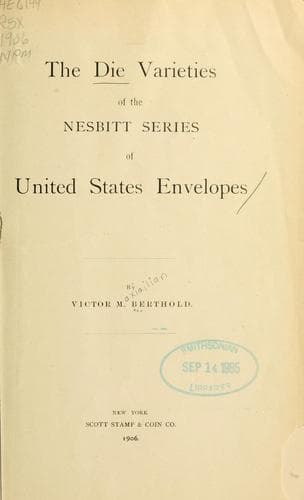
The Die Varieties of the Nesbitt Series of United States Envelopes — John Shaqi
The Die Varieties of the Nesbitt Series of United States EnvelopesBerthold, Victor Maximilian
History
The Die Varieties of the Nesbitt Series of United States Envelopes
Berthold, Victor Maximilian
Postage stamps -- United States
An heavy eyebrow near the corner of the eye. It extends to the
beginning of the side-lock, which is long, slim, almost straight, and
ends a little distance from the ear-lobe. Note that the point of the
side-lock is not turned up to the left. Together with the side-lock
starts the lowest front-lock. It is rather thin, slants across the
lobe, and is divided at the end, which is the main feature. Note that
it extends but a little distance beyond the lobe. Immediately above the
lowest strand is a second one, much longer than the first, forming the
commencement of the queue.
[Illustration]
Variety 10:--"THREE" high in label. "HR" very close. "CENTS" near outer
oval line. Base of "E" a little below that of "C". "EN" wide. "TS" near
at base.
HEAD IX.
[Illustration: IX.]
The side-lock starts above and far from the corner of the eye. It is
short, curves outward towards its end, and terminates a little distance
above the ear-lobe. Note that the ear-lobe is larger than usual and
extends quite a distance beyond the end of the side-lock. Together with
the side-lock commences the lowest bunch of hair, which resembles
somewhat a pear, i.e. slim at the start and bulging towards the base.
The hair is divided into two rows. The queue is in line with the back
row.
[Illustration]
Variety 11:--"CENTS" near inner oval line; "C" high, and a little
above level of "E". "CE" wide; "ENT" near at top. "S" close to curve.
"THREE" close to inner oval line. "HR" and "RE" wide at top.
HEAD X.
[Illustration: X.]
An heavy eyebrow starting upward from the bridge of the nose. A second
eyebrow is close to the corner of the eye. A long side-lock starts near
it and touches the ends in line with the ear-lobe. The hair is divided
into two parts, four locks in front and three in the back row. The
lowest lock in the front row is by far the heaviest. The hair is cut
round similar to Head 1. Note that the queue is in line with the second
row of hair.
[Illustration]
Variety 12:--"CENTS" close to inner frame line, especially "C". "THREE"
close to inner oval line. "ENT" near at base. The die resembles closely
Var. 9 with the exception of "C," which is high in the label.
* * * * *
Before leaving this issue some remarks about the paper and its various
tints may be useful. The writer well remembers that when he first took
up the study of these envelopes he was often sorely puzzled how to
classify a specimen. The general catalogue knows but two shades of
paper, white and buff, and is mute on the question of quality.
As a matter of fact the quality of the paper used for the first issue
varies from soft to a hard, brittle texture, from thin to thick, with a
dull or even highly glazed surface. A decided rarity is a kind of wove
paper, unwatermarked. We find fine laid lines, the cross lines near or
far, and two very distinct varieties of watermarks.
Public-domain text, read in full here on John Shaqi.
Reviews
Reviews
No reviews yet
Be the first to share your thoughts on this work.
Join the Discussion
Join the discussion
Sign in to leave a comment or review.
Sign InorCreate an account