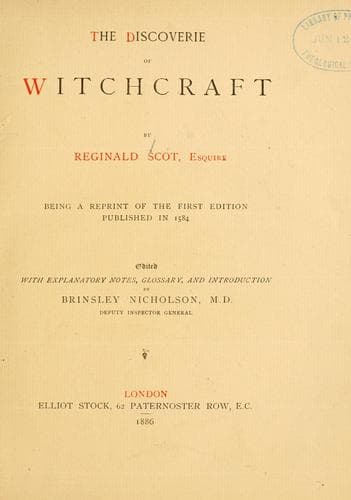
Demonology -- Early works to 1800; Magic -- Early works to 1800; Witchcraft -- Early works to 1800
On the 11th of October he married Jane—not, as stated in “The
Memorials”, Alice—Cobbe, the daughter of an old yeoman family long
resident at Cobbe’s Place, in the adjoining parish of Aldington. The
entry in the Registers of Brabourne is—
“M[*] Reignold Scott and Jane Cobbe
were maryed the xi^{th} of October 1658.”
[*] To this upper portion of the “M” is added a character which may
make it “Mr.” or “Married”; but I have not myself yet seen the entry.
The only issue of this marriage, the only issue (that at least
survived) of both his marriages—for the Maria in the table of “The
Memorials” was the daughter of his second wife by her first husband—was
Elizabeth, afterwards married to Sackville Turnor; and the only issue
of that marriage, prior at least to Reynold’s death in 1599, was
Cicely. Elizabeth’s birth must have been in or before 1574, for in the
Inquis. post mortem of Reg. Scot generosus in 1602, she is said to be
“28 et amplius”. The Holy Maid of Kent (mentioned by Scot, p. 26) was
servant to one of her maternal progenitors, probably to her grandfather.
In this year, 1574, was also published the first issue of his brain,
his tractate on _The Hoppe-Garden_, the first work, I believe, in which
not only was the culture of the hop in England advocated, both as
having been successfully tried by him, and as against its importation
from Poppering, in Flanders, where its mode of culture, etc., was
endeavoured to be kept secret; but the whole subject of its growth,
culture, drying, and preservation was gone into in a practical manner,
and further explained by woodcuts. And here it may be worth noting that
in this year Reynold was necessarily absent so far from London that the
publisher inserted this apologetic note: “Forasmuch as M. Scot could
not be present at the printing of this his Booke, whereby I might have
used his advise in the correction of the same, and especiallie of the
Figures and Portratures conteyned therein, whereof he delivered unto me
such notes as I being unskilfull in the matter, could not so thoroughly
conceyve, nor so perfectly expresse as ... the Author, or you ... the
Reader might in all poyntes be satisfied [etc., etc.].” In the second
edition, however, in 1576, it was: “Now newly corrected and augmented,”
the augmentations increasing the book from fifty-three pages, exclusive
of the epilogue, to sixty, and the corrections including one added and
one emended engraving. As a matter of curiosity, and as showing that
neither the publisher nor the author expected a second edition, it
may be added that though only two years had elapsed, some at least of
the wood engravings required to be re-cut in almost exact facsimile.
A third edition was issued in 1578, and from these we can date the
commencement of the hop harvests in Kent.
Public-domain text, read in full here on John Shaqi.
Reviews
Reviews
No reviews yet
Be the first to share your thoughts on this work.
Join the Discussion
Join the discussion
Sign in to leave a comment or review.
Sign InorCreate an account