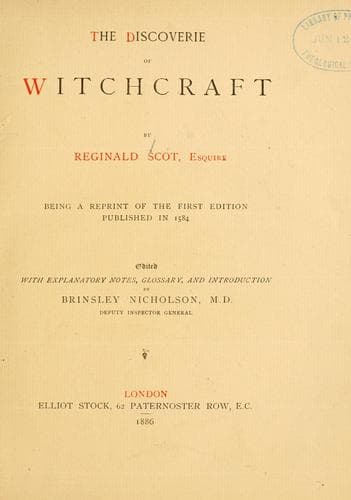
Demonology -- Early works to 1800; Magic -- Early works to 1800; Witchcraft -- Early works to 1800
♦_August. de civit. Dei._
_Isidor. lib. (8. cap. 9.)_
_Etymol. 26. quæ. 5. ca. nec mirum._
_Ponzivibius de lamiis, volum. 10._
_L. error, & L. cum post. c. de juris & facti ignor. ac in L. de ætat._
_§. item de interrog. actiō._
_Per glos. Bal. & alios in L. 1. c. de confes. glos. nec. si de confes.
in 6. § ad leg. Aquil L. Neracius. §. fin. Ut per Bald. & August. in
L. I. c. de confess, &c. Extra. de presump. literas. Per Bald. in d.
leg. &c._
_Extra. de test cum literis._
_Mal. Malef. pa. 3 quæst. 5. cap. 11._♦
The lawe also saith, _In criminalibus regulariter non statur soli
confessioni rei_, In criminall cases or touching life, we must not
absolutelie stand to the confession of the accused partie: but in
these matters proofes must be brought more cleare than the light it
selfe. And in this crime no bodie must be condemned upon presumptions.
And where it is objected and urged, that Since God onelie knoweth
the thoughts, therefore there is none other waie of proofe but by
confession: It is answered thus in the lawe, to wit: Their confession
in this case conteineth an outward act, and the same impossible both
in lawe and nature, and also unlikelie to be true; and therefore _Quod
verisimile non est, attendi non debet_. So as, though their confessions
may be worthie of punishment, as whereby they shew a will to commit
such mischeefe, yet not worthie of credit, as that they have such
power. For, _Si factum absit, soláque opinione laborent, é stultorum
genere sunt_; If they confesse a fact performed but in opinion, they
are to be reputed among the number of fooles. Neither may any man be
by lawe condemned for criminall causes, upon presumptions, nor yet by
single witnesses: neither at the accusation of a capitall enimie, who
indeed is not to be admitted to give evidence in this case; though it
please _M. Mal._ and _Bodin_ to affirme the contrarie. But beyond all
equitie, these inquisitors have shifts and devises enow, to plague and
kill these poore soules: for (they say) their fault is greatest of
all others; bicause of their carnall copulation with the divell, and
therefore they are to be punished as heretikes, foure maner of waies:
to wit; with excommunication, deprivation, losse of goods, and also
with death.
♦_Mal. malef. quæst. 14. pa. 1._♦
Public-domain text, read in full here on John Shaqi.
Reviews
Reviews
No reviews yet
Be the first to share your thoughts on this work.
Elsewhere in the archive
Join the Discussion
Join the discussion
Sign in to leave a comment or review.
Sign InorCreate an account