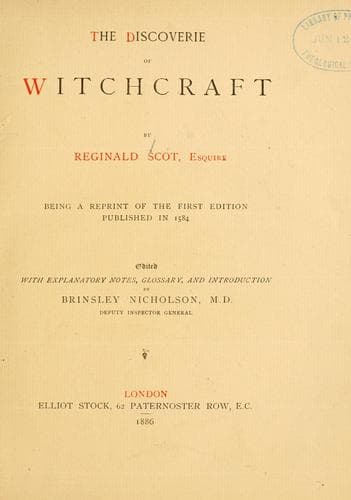
Demonology -- Early works to 1800; Magic -- Early works to 1800; Witchcraft -- Early works to 1800
When his first wife died and when he re-married is as yet unknown to
us. But this latter could hardly have taken place until the latter
end, at earliest, of 1584, since in that year he, as already quoted,
describes himself as, “having his foot under your [Sir Th. Scot’s]
table”, etc., or in other words, as being a dependant not worth one
groat. Nor do we know more of this second wife beyond these slight
particulars that we gather from Reynold’s will: that her Christian name
was Alice—given in “The Memorials” instead of Jane, to Cobbe, the first
wife—that she was a widow with a daughter by her former husband; and
that she had some land, either in her own right or derived from her
former husband. That she was a widow at the time of her remarriage is
shown by Reynold’s bequest of “six poundes thirteene shillings foure
pence to my daughter in Lawe Marie Collyar for apparell [? mourning]
desiring that her mother’s hand be not anie thinge the shorter towards
her in that respect.” Whether Collyar were this daughter’s maiden name,
and therefore the name of her mother’s first husband, or whether it
were the name of her own husband, is doubtful, though from the words
just quoted I rather incline to this second supposition, and that the
husband was not a man of much means. With regard to what I have said
as to the mother’s possession of property, it has been suggested to me
by one of good judgment, and a solicitor, that Reynold’s expression
as to not dying worth a groat was merely an excuse for leaving the
bulk of his property to his wife; as also that these concluding words
of the will, and the resistance of probate to it made by Elizabeth,
his daughter by his first wife, indicate the existence of family
differences, probably attributable to this second marriage having been
entered into with one of a social rank inferior to his own. I cannot,
however, deduce this latter supposition from anything we know, neither
can I thus interpret the last words of his will, nor believe him guilty
of such a perversion of the truth. Reading his will attentively, I
think we find that Scot, with his usual fine sense of justice, gives
all the lands in “Aldington, Ruckinge, and Sellinge”, which had become
his by his marriage with Alice, “to her and _to her_ [not to his]
heires”, while he only gives his lands in Romney Marsh and his lease
of Brabourne Rectory to her for _her life_, and then the lease at
least, which had come to him “from his Cozen Charles”, to his daughter
Elizabeth. Reading the last words of his will verbatim, I think it
consistent with justice to hold, that though he may have obtained these
lands in Romney Marsh through the use of what had been his wife’s
former property, but was during his marriage his own, he was entitled
to leave them to his wife only for her life, they then proceeding not,
as did the others, to her heirs, but to his. I strongly suspect, also,
that his casual omission of any directions as to whom these Romney
Public-domain text, read in full here on John Shaqi.
Reviews
Reviews
No reviews yet
Be the first to share your thoughts on this work.
Join the Discussion
Join the discussion
Sign in to leave a comment or review.
Sign InorCreate an account